How to Calculate an Appliance’s Electricity Cost From Watts
Want to know how much an appliance costs to run? If you know its wattage, how long you use it, and your electricity rate, you can estimate its electricity cost with a simple calculation.
The basic formula is:
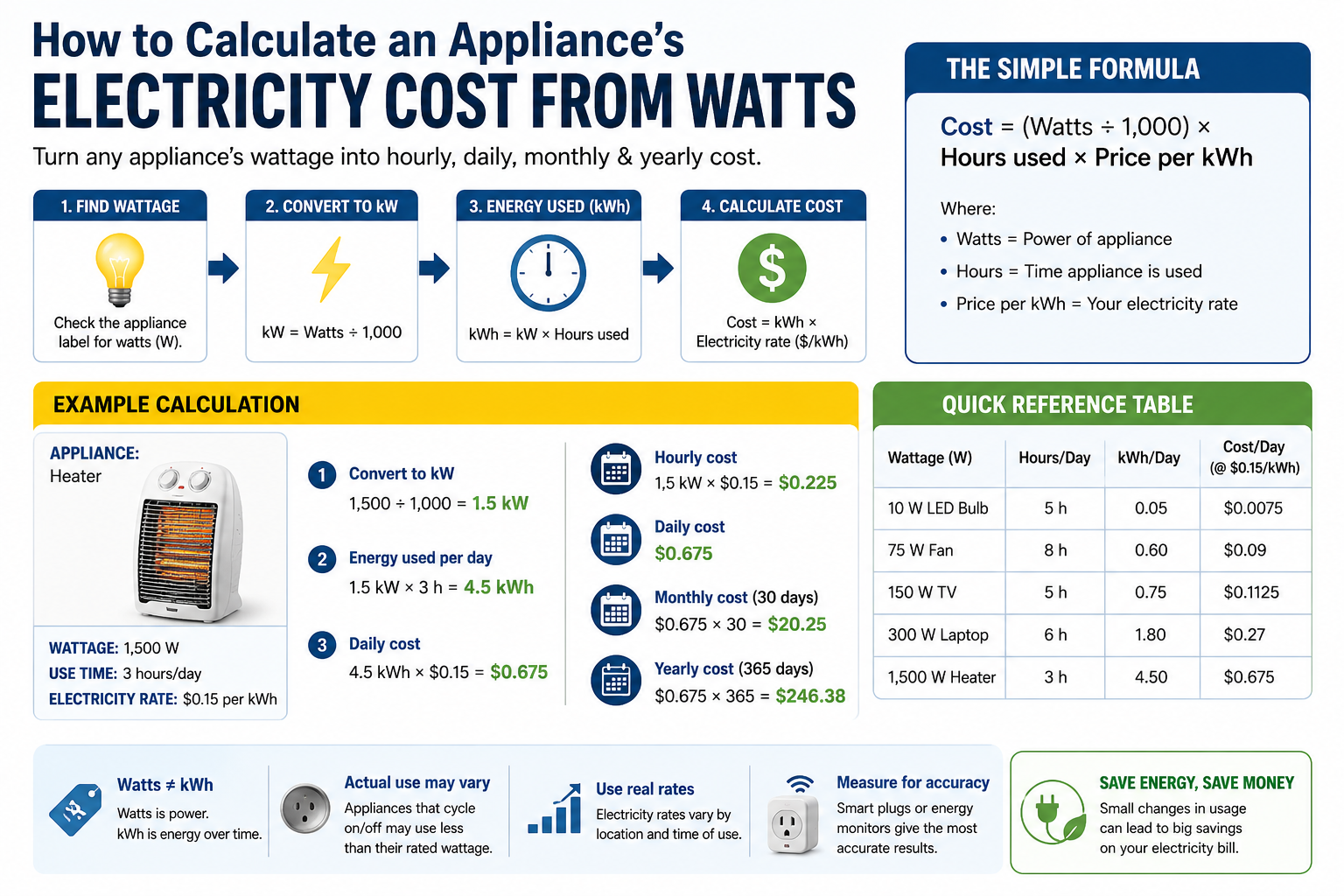
Electricity cost = (Watts ÷ 1,000) × Hours used × Electricity rate per kWh
For example, a 1,000-watt appliance running for 3 hours uses approximately 3 kWh of electricity. If electricity costs $0.15 per kWh, the estimated cost is $0.45.
The important thing to remember is that watts measure power, while kilowatt-hours measure energy used over time. Electricity utilities generally bill customers based on kilowatt-hours (kWh).
What Information Do You Need to Calculate Appliance Electricity Cost?
You only need three main pieces of information:
- Appliance wattage
- How many hours the appliance operates
- Your electricity price per kWh
You can usually find an appliance’s wattage on its rating label, specification sheet, or manufacturer’s documentation.
If the appliance gives you amps and volts instead of watts, you can often estimate its power using:
Watts = Volts × Amps
The U.S. Department of Energy uses this relationship in its appliance energy education materials.
Once you have the wattage, you can convert it to kilowatts.
1 kilowatt = 1,000 watts
So:
Kilowatts = Watts ÷ 1,000
The EIA confirms that one kilowatt equals 1,000 watts and that electricity consumption over time is measured in watt-hours or kilowatt-hours.
The Simple Formula for Calculating Electricity Cost
Use this formula:
Cost = (Watts ÷ 1,000) × Hours × Price per kWh
Let’s break it down.
Step 1: Convert watts to kilowatts
Divide the appliance’s wattage by 1,000.
For a 1,500-watt heater:
1,500 ÷ 1,000 = 1.5 kW
Step 2: Multiply by hours of use
If you operate the heater for 2 hours:
1.5 kW × 2 hours = 3 kWh
Step 3: Multiply by your electricity rate
If your electricity rate is $0.15 per kWh:
3 kWh × $0.15 = $0.45
So the estimated electricity cost is:
$0.45 for 2 hours
The DOE provides a similar calculation example, converting 1,500 watts to 1.5 kW, multiplying by hours of operation, and then multiplying the resulting kWh by the electricity rate.
How to Calculate Electricity Cost Per Hour
To calculate the approximate cost of running an appliance for one hour, use:
Hourly cost = (Watts ÷ 1,000) × electricity rate
For example, suppose a fan uses 75 watts and your electricity rate is $0.15 per kWh.
First convert watts to kilowatts:
75 ÷ 1,000 = 0.075 kW
Then:
0.075 × $0.15 = $0.01125
So the fan costs approximately 1.1 cents per hour at that electricity rate.
Remember that this is an estimate based on the appliance using 75 watts continuously.
How to Calculate Electricity Cost Per Day
If you know how many hours an appliance operates each day, use:
Daily cost = (Watts ÷ 1,000) × Hours per day × Price per kWh
Example
Suppose a 100-watt device operates for 8 hours each day.
100 ÷ 1,000 = 0.1 kW
Then:
0.1 × 8 = 0.8 kWh per day
At $0.15 per kWh:
0.8 × $0.15 = $0.12 per day
So the estimated daily electricity cost is $0.12.
How to Calculate Monthly Electricity Cost
For a simple estimate, multiply the daily energy consumption by the number of days in the month.
The formula is:
Monthly cost = (Watts ÷ 1,000) × Hours per day × Days × Price per kWh
Example
Imagine a 500-watt appliance that operates for 4 hours every day.
Convert watts:
500 ÷ 1,000 = 0.5 kW
Daily energy:
0.5 × 4 = 2 kWh
For a 30-day month:
2 × 30 = 60 kWh
At $0.15 per kWh:
60 × $0.15 = $9
The estimated monthly electricity cost is therefore $9.
Your actual cost can be different if the appliance doesn’t continuously consume its rated wattage or if your electricity rate changes.
How to Calculate Annual Electricity Cost
You can extend the same formula over a year.
Annual cost = (Watts ÷ 1,000) × Hours per day × 365 × Price per kWh
Using the previous 500-watt appliance:
0.5 kW × 4 hours × 365 = 730 kWh
At $0.15 per kWh:
730 × $0.15 = $109.50
So the estimated annual electricity cost would be $109.50.
The Department of Energy uses annual energy-use and annual-cost calculations for appliances, but its published examples also make clear that actual energy use depends on operating conditions and usage patterns.
What Is the Difference Between Watts and kWh?
This is one of the most important concepts to understand.
Watts measure power
Watts (W) tell you the rate at which an electrical device uses power at a particular moment.
Kilowatt-hours measure energy
Kilowatt-hours (kWh) measure the amount of electrical energy consumed over time.
The EIA explains that one watt is a unit of power, while watt-hours measure electricity used over a period of time. One kWh represents 1,000 watts used for one hour.
For example:
1,000 watts × 1 hour = 1 kWh
Likewise:
500 watts × 2 hours = 1 kWh
And:
100 watts × 10 hours = 1 kWh
This is why an appliance with relatively low wattage can still use a significant amount of electricity if it operates for many hours.
How to Calculate Electricity Cost When an Appliance Runs for Minutes
Not every appliance operates for a whole number of hours.
If an appliance runs for 30 minutes, convert the time into hours:
30 minutes ÷ 60 = 0.5 hours
For 15 minutes:
15 ÷ 60 = 0.25 hours
For 45 minutes:
45 ÷ 60 = 0.75 hours
Example
Suppose a 1,200-watt appliance runs for 30 minutes.
Convert watts:
1,200 ÷ 1,000 = 1.2 kW
Convert time:
30 minutes ÷ 60 = 0.5 hours
Energy used:
1.2 × 0.5 = 0.6 kWh
At $0.15 per kWh:
0.6 × $0.15 = $0.09
So the estimated cost is 9 cents.
Appliance Electricity Cost Formula at a Glance
| What you want to know | Formula |
|---|---|
| Kilowatts | Watts ÷ 1,000 |
| kWh used | kW × hours |
| Hourly cost | kW × electricity rate |
| Daily cost | kW × daily hours × electricity rate |
| Monthly cost | kW × daily hours × days × electricity rate |
| Annual cost | kW × daily hours × 365 × electricity rate |
The core relationship is simply energy = power × time, with watts converted to kilowatts when calculating kWh. DOE educational materials use this same approach.
How to Calculate the Cost of Multiple Appliances
You can use the same method for several appliances and add the results together.
For example, suppose you have:
- 100 W fan
- 150 W television
- 60 W computer monitor
If each operates for 5 hours per day:
Fan
100 ÷ 1,000 × 5 = 0.5 kWh/day
TV
150 ÷ 1,000 × 5 = 0.75 kWh/day
Monitor
60 ÷ 1,000 × 5 = 0.3 kWh/day
Total:
0.5 + 0.75 + 0.3 = 1.55 kWh/day
You can then multiply 1.55 kWh by your electricity rate to estimate the combined daily cost.
This can be useful when trying to identify which devices contribute most to your home’s electricity consumption.
Does the Wattage on an Appliance Mean It Uses That Much Electricity All the Time?
Not necessarily.
The wattage printed on an appliance can represent a rated or maximum power level rather than its actual average consumption during every moment of operation.
Some appliances operate at different power levels. Others turn components on and off automatically.
For example, a refrigerator doesn’t necessarily draw the same amount of power continuously. Its compressor cycles as needed.
Heating and cooling equipment can also change their electricity consumption depending on operating conditions.
This means a calculation based on the label wattage is best treated as an estimate, especially for appliances whose power demand changes over time.
DOE appliance energy calculations similarly use defined operating assumptions rather than assuming that every appliance operates at its rated power continuously.
How to Get a More Accurate Electricity Cost
If you want a better estimate of actual consumption, measure the appliance rather than relying only on its label.
An energy-monitoring smart plug can be useful for compatible plug-in appliances because it can track actual electrical use over time.
Instead of assuming:
Appliance = 500 W continuously
you can measure how much energy it actually consumes during a day or week.
This is especially helpful for appliances that:
- Cycle on and off
- Have different operating modes
- Spend significant time in standby
- Automatically adjust their power consumption
For more demanding or hardwired equipment, a suitable electrical monitoring device may be more appropriate than a consumer smart plug.
How Electricity Rates Affect Appliance Cost
The same appliance can cost different amounts to operate depending on the electricity rate.
For example, suppose an appliance consumes 5 kWh.
At $0.10 per kWh:
5 × $0.10 = $0.50
At $0.20 per kWh:
5 × $0.20 = $1.00
At $0.30 per kWh:
5 × $0.30 = $1.50
Electricity prices vary by location, customer type, utility, and pricing structure. Some utilities also use time-of-use rates, meaning the price can change depending on when electricity is consumed.
For the most accurate calculation, use the actual per-kWh rate that applies to your electricity bill rather than relying on a generic national average.
What About Taxes, Fees, and Other Charges?
The simple formula estimates the energy portion of the cost:
kWh × price per kWh
Your actual electricity bill may include additional charges, such as:
- Fixed service charges
- Delivery or distribution charges
- Taxes
- Government fees
- Other utility charges
- Different rates for different usage levels
Therefore, an appliance calculation shouldn’t necessarily be expected to match the exact increase in your final bill.
Electricity pricing can contain multiple components, and the EIA notes that electricity prices reflect factors including generation, transmission, distribution, and other costs.
Quick Appliance Electricity Cost Examples
Here are a few hypothetical examples using an electricity rate of $0.15 per kWh.
| Appliance | Wattage | Daily Use | Estimated Daily Energy | Estimated Daily Cost |
|---|---|---|---|---|
| LED lamp | 10 W | 5 hours | 0.05 kWh | $0.0075 |
| Fan | 75 W | 8 hours | 0.60 kWh | $0.09 |
| TV | 150 W | 5 hours | 0.75 kWh | $0.1125 |
| Computer | 300 W | 6 hours | 1.80 kWh | $0.27 |
| Heater | 1,500 W | 3 hours | 4.50 kWh | $0.675 |
These are illustrative calculations, not universal consumption figures. Actual power use varies by appliance model and operating conditions.
What Appliance Uses the Most Electricity?
You can’t determine an appliance’s total electricity cost from wattage alone.
Two factors matter:
Power × time
A 1,500-watt heater used for 30 minutes might consume less electricity than a 100-watt device operating continuously for a much longer period.
For example:
1,500 W × 0.5 hours = 0.75 kWh
while:
100 W × 10 hours = 1 kWh
So the lower-wattage device can consume more total energy if it operates for longer.
DOE educational materials make the same point: determining electricity consumption requires knowing both an item’s power and how long it operates.
How to Find an Appliance’s Wattage
Look for a label on the appliance or its power adapter.
You may see:
- Watts (W)
- Amps (A)
- Volts (V)
- Voltage and current ratings
- A model number that can be checked against manufacturer specifications
If you have volts and amps, a basic estimate is:
Watts = Volts × Amps
For example:
120 V × 5 A = 600 W
However, actual AC power consumption can be more complicated for certain equipment, so this calculation should be treated as an estimate when you’re working from nameplate voltage and current rather than an actual power measurement.
Common Mistakes When Calculating Appliance Electricity Cost
Mistake 1: Treating watts as kWh
A 500-watt appliance does not automatically use 500 kWh.
Watts are power; kWh is energy consumed over time.
Mistake 2: Forgetting to divide watts by 1,000
You need to convert watts to kilowatts before calculating kWh:
500 W ÷ 1,000 = 0.5 kW
Mistake 3: Ignoring operating time
A wattage rating alone isn’t enough to calculate energy consumption.
You need:
Power × time = energy
Mistake 4: Using the wrong electricity rate
Use the rate that applies to your electricity plan.
Mistake 5: Assuming rated wattage is constant
Some appliances cycle or change their power demand.
Mistake 6: Assuming the estimate equals your bill
The simple calculation generally estimates energy charges, not every fee and charge appearing on an electricity bill.
A Simple Formula You Can Save
If you only remember one formula, use this:
Appliance electricity cost = (Watts ÷ 1,000) × Hours used × Cost per kWh
For monthly calculations:
Monthly cost = (Watts ÷ 1,000) × Hours per day × Days per month × Cost per kWh
For annual calculations:
Annual cost = (Watts ÷ 1,000) × Hours per day × 365 × Cost per kWh
These formulas follow the basic energy relationship used in DOE educational guidance.
Frequently Asked Questions
How do I calculate electricity cost from watts?
Divide the appliance’s watts by 1,000 to convert watts to kilowatts. Multiply by the number of hours used, then multiply by your electricity price per kWh.
Formula: (Watts ÷ 1,000) × hours × price per kWh
How much does a 100-watt appliance cost to run?
At an electricity rate of $0.15 per kWh, a 100-watt appliance running continuously for one hour uses 0.1 kWh and costs approximately $0.015, or 1.5 cents.
How much does a 1,000-watt appliance cost per hour?
A 1,000-watt appliance equals 1 kW. Therefore, its hourly cost is simply your electricity rate per kWh, assuming it continuously consumes 1,000 watts.
At $0.15/kWh, that’s approximately $0.15 per hour.
How do I calculate kWh from watts?
Use:
kWh = Watts × hours ÷ 1,000
For example, 500 watts used for 4 hours equals:
500 × 4 ÷ 1,000 = 2 kWh
Can I calculate electricity cost without knowing watts?
You need some measure of power or energy consumption. If you know amps and volts, you can estimate watts. Alternatively, an energy monitor can measure actual electricity consumption.
Is appliance wattage the same as actual electricity consumption?
Not always. Some appliances vary their power consumption or cycle on and off, so the rated wattage may not represent their average power use.
Is kWh the unit used on electricity bills?
Generally, yes. Electricity utilities commonly measure energy consumption in kilowatt-hours.
How can I calculate the cost of an appliance for a whole month?
Use:
Monthly cost = (Watts ÷ 1,000) × hours per day × days × price per kWh
For appliances with changing power consumption, actual measured kWh will generally give you a better estimate.
Final Takeaway
Calculating an appliance’s electricity cost from watts is straightforward once you understand the difference between power and energy.
Remember these three steps:
1. Convert watts to kilowatts
Watts ÷ 1,000 = kW
2. Calculate energy consumption
kW × hours = kWh
3. Calculate the electricity cost
kWh × electricity rate = cost
The resulting figure is an estimate based on the wattage and operating time you entered. For appliances that change their power consumption, measuring actual kWh over time can provide a more realistic result.
Once you know this formula, you can estimate the running cost of almost any compatible electrical appliance—from a small lamp or fan to a heater, computer, refrigerator, or other household equipment.