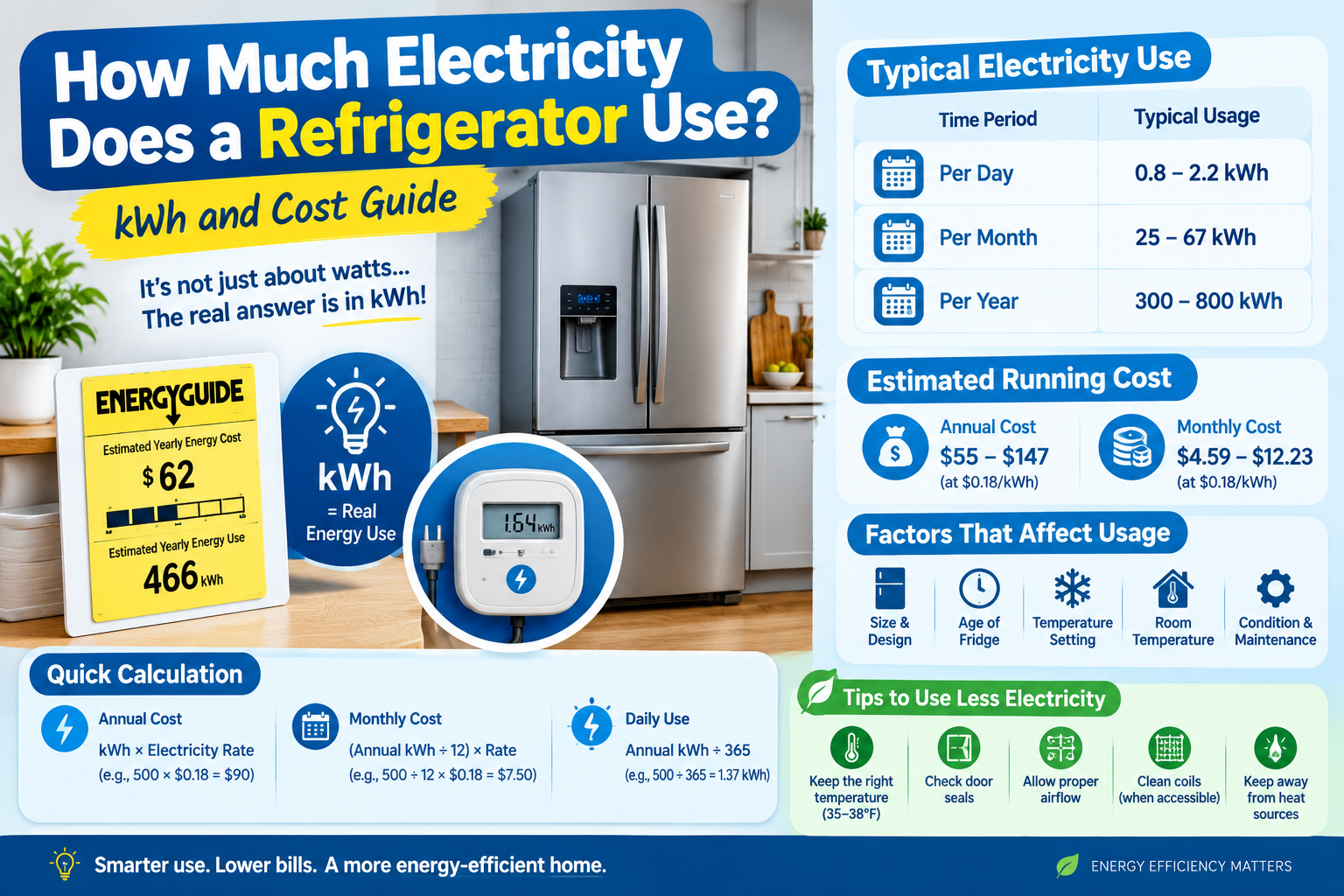
How Much Electricity Does a Refrigerator Use? kWh & Cost Guide
A refrigerator typically uses hundreds of kilowatt-hours (kWh) of electricity per year, but the exact amount depends on its size, age, design, efficiency, temperature, and how it is used.
For a modern refrigerator, a reasonable planning range is roughly 300–800 kWh per year, although individual models can fall outside that range. Current ENERGY STAR-certified refrigerators show substantial variation in annual energy use depending on their size and configuration.
The most accurate way to find out how much electricity your refrigerator uses is to check its EnergyGuide label or manufacturer’s specifications for the estimated annual kWh consumption. The Federal Trade Commission says EnergyGuide labels provide estimated annual energy use and operating cost information for refrigerators and other major appliances.
Quick Answer: How Much Electricity Does a Refrigerator Use?
A modern household refrigerator commonly uses around 300–800 kWh per year, depending on its size and design.
That works out to approximately:
| Period | Typical consumption |
|---|---|
| Per day | About 0.8–2.2 kWh |
| Per month | About 25–67 kWh |
| Per year | About 300–800 kWh |
A current analysis of thousands of ENERGY STAR-certified refrigerators found an average of about 493 kWh per year, but this is an average across a particular dataset—not a guaranteed consumption figure for every refrigerator.
Your refrigerator’s actual consumption may be considerably higher if it is very old, oversized, poorly sealed, installed in a hot location, or inefficient.
Refrigerator Watts vs. kWh: What’s the Difference?
This is where many refrigerator electricity calculations go wrong.
Watts (W) measure the rate at which an appliance uses electrical power at a particular moment.
Kilowatt-hours (kWh) measure the amount of electricity consumed over time.
Your electricity company generally bills you based on kWh, not simply the refrigerator’s watt rating.
For example, a refrigerator might draw significantly more power while its compressor is operating and much less when the compressor shuts off. Refrigerators cycle their cooling systems on and off rather than continuously drawing their full operating wattage.
That means you should not simply take a refrigerator’s wattage and assume it runs at that level for 24 hours every day.
Simple formula
If you know the actual average power consumption:
Electricity used = Watts × hours ÷ 1,000
For example:
500 W × 24 hours ÷ 1,000 = 12 kWh
But this calculation assumes the appliance actually draws 500 watts continuously for all 24 hours.
A refrigerator normally doesn’t.
For a refrigerator, the annual kWh figure on the EnergyGuide label is usually a better starting point because it is intended to represent annual energy consumption under standardized testing conditions.
How Much Electricity Does a Refrigerator Use Per Day?
If your refrigerator uses:
- 300 kWh/year: about 0.82 kWh/day
- 400 kWh/year: about 1.10 kWh/day
- 500 kWh/year: about 1.37 kWh/day
- 600 kWh/year: about 1.64 kWh/day
- 800 kWh/year: about 2.19 kWh/day
- 1,000 kWh/year: about 2.74 kWh/day
The calculation is simple:
Annual kWh ÷ 365 = daily kWh
For example, a refrigerator rated at 500 kWh/year:
500 ÷ 365 = 1.37 kWh per day
This is a much more useful number for estimating electricity consumption than simply looking at the compressor’s wattage.
How Much Electricity Does a Refrigerator Use Per Month?
Divide the annual consumption by 12.
| Annual refrigerator use | Approx. monthly use |
|---|---|
| 300 kWh | 25 kWh |
| 400 kWh | 33 kWh |
| 500 kWh | 42 kWh |
| 600 kWh | 50 kWh |
| 800 kWh | 67 kWh |
| 1,000 kWh | 83 kWh |
For example, a refrigerator rated at 500 kWh/year would use approximately:
500 ÷ 12 = 41.7 kWh per month
Your actual monthly usage can vary with room temperature, door openings, thermostat settings, refrigerator condition, and seasonal conditions.
How Much Does It Cost to Run a Refrigerator?
The easiest calculation is:
Annual electricity cost = Annual kWh × Your electricity rate
For example, suppose your refrigerator uses 500 kWh per year and your electricity rate is $0.18 per kWh.
500 × $0.18 = $90 per year
That’s:
- $90 per year
- $7.50 per month
- About $0.25 per day
Your own cost will depend on your electricity tariff.
The U.S. Energy Information Administration reported an average residential electricity price of about 18.34 cents/kWh in June 2026, while its May 2026 figure was 18.44 cents/kWh.
Using 18.34 cents/kWh as an example:
| Refrigerator use | Approx. annual cost | Approx. monthly cost |
|---|---|---|
| 300 kWh | $55 | $4.59 |
| 400 kWh | $73 | $6.11 |
| 500 kWh | $92 | $7.64 |
| 600 kWh | $110 | $9.17 |
| 800 kWh | $147 | $12.23 |
| 1,000 kWh | $183 | $15.28 |
Important: These are examples, not universal electricity costs. Replace $0.1834/kWh with the rate on your own electricity bill.
How to Find Your Refrigerator’s Exact Electricity Usage
The easiest method is to find the refrigerator’s EnergyGuide label.
The FTC requires EnergyGuide labeling for refrigerators and refrigerator-freezers sold in the United States. The label provides information that helps consumers compare energy consumption and operating costs between similar models.
Look for a number such as:
“Estimated Yearly Energy Use: 500 kWh”
Then use:
Annual cost = 500 × your electricity rate
If the label isn’t available, check:
- The refrigerator owner’s manual.
- The manufacturer’s website.
- The refrigerator model number.
- The manufacturer’s energy specification.
- An electricity-monitoring device.
The U.S. Department of Energy also provides a refrigerator and freezer energy-rating database that can be searched by appliance type, brand, model number, and manufacturing year.
How Many Watts Does a Refrigerator Use?
You will often see refrigerator wattage estimates of around 300–800 watts, but this figure can be misleading if interpreted as continuous electricity consumption.
The refrigerator’s compressor cycles on and off.
While cooling, the compressor and other components can draw considerably more power. Once the target temperature is reached, the compressor switches off or reduces its activity.
This is why a refrigerator with a particular watt rating should not automatically be assumed to consume that many watts continuously for 24 hours.
For estimating the electricity bill, annual kWh is the more useful number.
How Much Electricity Does a Refrigerator Use Compared With Other Types?
Refrigerator design makes a significant difference.
ENERGY STAR recommends appropriately sizing your refrigerator and notes that larger refrigerators generally consume more energy. It also says top-freezer models typically use less energy than bottom-freezer and side-by-side configurations.
As a general planning guide:
| Refrigerator type | Typical energy tendency |
|---|---|
| Small compact refrigerator | Low |
| Single-door refrigerator | Low to moderate |
| Top-freezer refrigerator | Usually among the more efficient full-size designs |
| Bottom-freezer refrigerator | Moderate |
| French-door refrigerator | Moderate to high |
| Side-by-side refrigerator | Often higher |
| Large refrigerator with ice/water dispenser | Often higher |
These are general tendencies, not guarantees. Two refrigerators with the same design can have very different EnergyGuide ratings.
For example, current ENERGY STAR-certified side-by-side models include products rated around 420–613 kWh/year, illustrating how much variation can exist even within one refrigerator category.
Do Old Refrigerators Use More Electricity?
Yes, older refrigerators can use substantially more electricity than modern efficient models.
ENERGY STAR says refrigerators more than 15 years old can cost about $95 more per year to run than new ENERGY STAR models, although the actual difference depends on the refrigerator and electricity price.
Historical Department of Energy data also shows how refrigerator energy consumption has fallen over the decades. Shipment-weighted average consumption was around 988 kWh/year for 1990 models, compared with substantially lower averages for later model years in the same DOE dataset.
That means an old refrigerator can become an important hidden electricity expense.
If you have a second refrigerator in a garage or basement, its age and operating environment are particularly worth considering.
What Makes a Refrigerator Use More Electricity?
Several factors can increase energy consumption.
1. High room temperature
A refrigerator has to remove heat from inside the cabinet.
If the surrounding room is very hot, the cooling system has to work harder.
This can be especially important if the refrigerator is located in:
- A hot garage
- A poorly ventilated kitchen
- Direct sunlight
- Near an oven
- Near another heat-producing appliance
ENERGY STAR recommends keeping refrigerators away from heat sources and allowing adequate airflow.
2. Poor door seals
A damaged or loose gasket allows cold air to escape.
The refrigerator then has to work harder to maintain its temperature.
Check that the door closes properly and that the gasket seals evenly around the entire opening.
3. Frequent door opening
Every time the door opens, cold air escapes and warmer air enters.
Keeping the door closed as much as possible reduces unnecessary cooling work.
4. Incorrect temperature setting
ENERGY STAR recommends keeping a refrigerator around 35–38°F.
Setting the refrigerator substantially colder than necessary can increase energy consumption.
5. Poor ventilation
A refrigerator needs to release the heat removed from its interior.
If airflow around the appliance is restricted, it may have to work harder.
Follow the clearance recommendations in your owner’s manual.
6. Dirty condenser coils
On models where accessible condenser coils require cleaning, dust buildup can reduce heat transfer.
ENERGY STAR recommends keeping condenser coils clean on older models, following the manufacturer’s instructions.
7. Oversized refrigerator
A larger refrigerator generally requires more energy than a smaller one.
ENERGY STAR specifically recommends buying an appropriately sized refrigerator rather than automatically choosing the largest model.
How to Reduce Refrigerator Electricity Consumption
You don’t necessarily need to replace your refrigerator to reduce its electricity use.
Try these steps first:
Keep the temperature reasonable
Set the refrigerator to approximately 35–38°F, following your manufacturer’s recommendations.
Check the door gasket
Look for cracks, gaps, or sections that aren’t sealing correctly.
Keep the refrigerator away from heat
Avoid placing it directly beside an oven or in direct sunlight.
Allow proper airflow
Maintain the clearance recommended by the manufacturer.
Don’t leave the door open
Decide what you need before opening the refrigerator and close it promptly.
Keep the refrigerator reasonably full
A properly loaded refrigerator can help maintain temperature, but don’t block vents or overfill the cabinet.
Clean accessible coils when appropriate
Follow the manufacturer’s instructions before cleaning any components.
Consider replacing a very old refrigerator
If your refrigerator is more than 15 years old, compare its estimated annual electricity consumption with that of a modern ENERGY STAR model. ENERGY STAR says older refrigerators can cost significantly more to operate.
Is an ENERGY STAR Refrigerator Worth It?
An ENERGY STAR-certified refrigerator is designed to exceed federal minimum efficiency requirements.
ENERGY STAR currently states that certified refrigerators are about 9% more energy efficient than models meeting the federal minimum efficiency standard.
However, don’t choose a refrigerator based only on the ENERGY STAR logo.
Compare:
- Annual kWh
- Refrigerator capacity
- Configuration
- Purchase price
- Features
- Your local electricity rate
A smaller refrigerator with a lower annual kWh rating may be cheaper to operate than a much larger model simply because it has less space to cool.
How to Measure Your Refrigerator’s Actual Electricity Use
If you want to know what your refrigerator is really consuming rather than relying on a label estimate, you can use a suitable plug-in electricity monitor.
The monitor can show how many kWh the refrigerator consumes over a period of several days or weeks.
For a more meaningful result:
- Connect the refrigerator to the energy monitor.
- Leave it operating normally.
- Record the kWh reading.
- Monitor it for at least several days.
- Calculate the average daily consumption.
- Multiply the daily figure by approximately 365 for an annual estimate.
For example, if your refrigerator averages:
1.5 kWh/day
Then:
1.5 × 365 = 548 kWh/year
This gives you a practical estimate based on the refrigerator’s actual environment and usage.
Does a Refrigerator Run 24 Hours a Day?
The refrigerator remains powered 24 hours a day, but its compressor does not necessarily run continuously.
The cooling system cycles according to the refrigerator’s temperature requirements.
That is why saying “my refrigerator is 500 watts” does not automatically mean:
500 W × 24 hours × 365 days
would be the refrigerator’s yearly consumption.
That calculation assumes a continuous 500-watt load and can dramatically overestimate consumption.
For a refrigerator, use the annual kWh rating whenever it is available.
How Much Electricity Does a Mini Fridge Use?
Mini refrigerators generally consume less electricity than full-size household refrigerators because they have much less interior volume to cool.
However, consumption varies substantially by size, design, age, insulation, and efficiency.
Current ENERGY STAR-certified compact refrigerators show annual energy figures that can be well below those of full-size refrigerators.
The best way to estimate your mini fridge’s consumption is still the same:
Annual kWh × electricity rate = annual operating cost
Does a Refrigerator Use More Electricity in Summer?
It can.
When the surrounding temperature rises, the refrigerator has to reject more heat into the room.
A refrigerator located in a very hot garage can therefore use more electricity than the same refrigerator operating in a temperature-controlled kitchen.
The effect depends on the refrigerator design and environmental conditions.
ENERGY STAR recommends placing refrigerators away from heat sources and maintaining appropriate airflow.
Is a Refrigerator a Major Electricity User?
A refrigerator is unusual because it operates around the clock.
Even though its compressor cycles on and off, it continues consuming electricity throughout the year.
That’s why a refrigerator’s annual kWh rating is more useful than looking only at its instantaneous wattage.
The actual impact on your electric bill depends on:
- Annual kWh consumption
- Electricity price
- Refrigerator age
- Refrigerator size
- Climate
- Door usage
- Temperature setting
- Condition of the door seal
- Refrigerator location
Quick Refrigerator Electricity Calculator
Use this formula:
Annual cost
Annual kWh × electricity price per kWh
Monthly cost
Annual kWh ÷ 12 × electricity price per kWh
Daily consumption
Annual kWh ÷ 365
Example
Suppose your refrigerator uses 600 kWh/year and your electricity rate is $0.18/kWh.
Annual cost:
600 × $0.18 = $108
Monthly cost:
$108 ÷ 12 = $9
Daily consumption:
600 ÷ 365 = 1.64 kWh/day
So that refrigerator would use approximately 1.64 kWh per day and cost about $108 per year at that electricity rate.
Frequently Asked Questions
How many kWh does a refrigerator use per day?
A typical modern refrigerator may use roughly 0.8–2.2 kWh per day, based on an annual consumption range of about 300–800 kWh. Actual usage varies by model and conditions.
How many watts does a refrigerator use?
Refrigerator wattage varies considerably. Published estimates can range from a few hundred watts or more while cooling, but the compressor cycles on and off. Therefore, wattage alone is not a reliable way to estimate annual electricity consumption.
How much does it cost to run a refrigerator per month?
It depends on the refrigerator’s annual kWh rating and your electricity price. For example, a 500-kWh/year refrigerator costs about $7.64 per month at $0.1834/kWh.
Does an old refrigerator use more electricity?
Often, yes. Older refrigerators generally use more energy than modern efficient models. ENERGY STAR says refrigerators more than 15 years old can cost about $95 more per year to operate than new ENERGY STAR models, depending on circumstances.
Does a refrigerator use electricity even when the compressor is off?
Yes. Other components such as controls, lights, fans, and defrost systems can consume electricity, while the compressor cycles on and off.
What is the best way to find my refrigerator’s electricity consumption?
Check the refrigerator’s EnergyGuide label for annual kWh consumption, then multiply that figure by your electricity rate. You can also use an appropriate electricity monitor to measure real-world consumption.
Do bigger refrigerators use more electricity?
Generally, yes. ENERGY STAR states that larger refrigerators generally consume more energy, although efficiency varies between models.
Does an ENERGY STAR refrigerator use less electricity?
ENERGY STAR-certified refrigerators meet efficiency requirements above the federal minimum standard. ENERGY STAR currently says certified refrigerators are about 9% more efficient than models meeting the federal minimum standard.
Final Takeaway
So, how much electricity does a refrigerator use?
A reasonable starting range for a modern household refrigerator is about 300–800 kWh per year, but your refrigerator may use significantly more or less depending on its size, design, age, efficiency, and operating environment.
Don’t rely on the refrigerator’s wattage alone.
Instead, look for the annual kWh figure on the EnergyGuide label and use:
Annual cost = kWh/year × your electricity rate
If your refrigerator is old, oversized, poorly sealed, located somewhere hot, or has a high annual kWh rating, it may be costing considerably more to operate than a modern efficient model.
The most useful number to compare when shopping—or diagnosing a high electricity bill—is annual kWh, not simply watts.