Can a Smart Plug Measure Electricity Usage? How Energy Monitoring Works
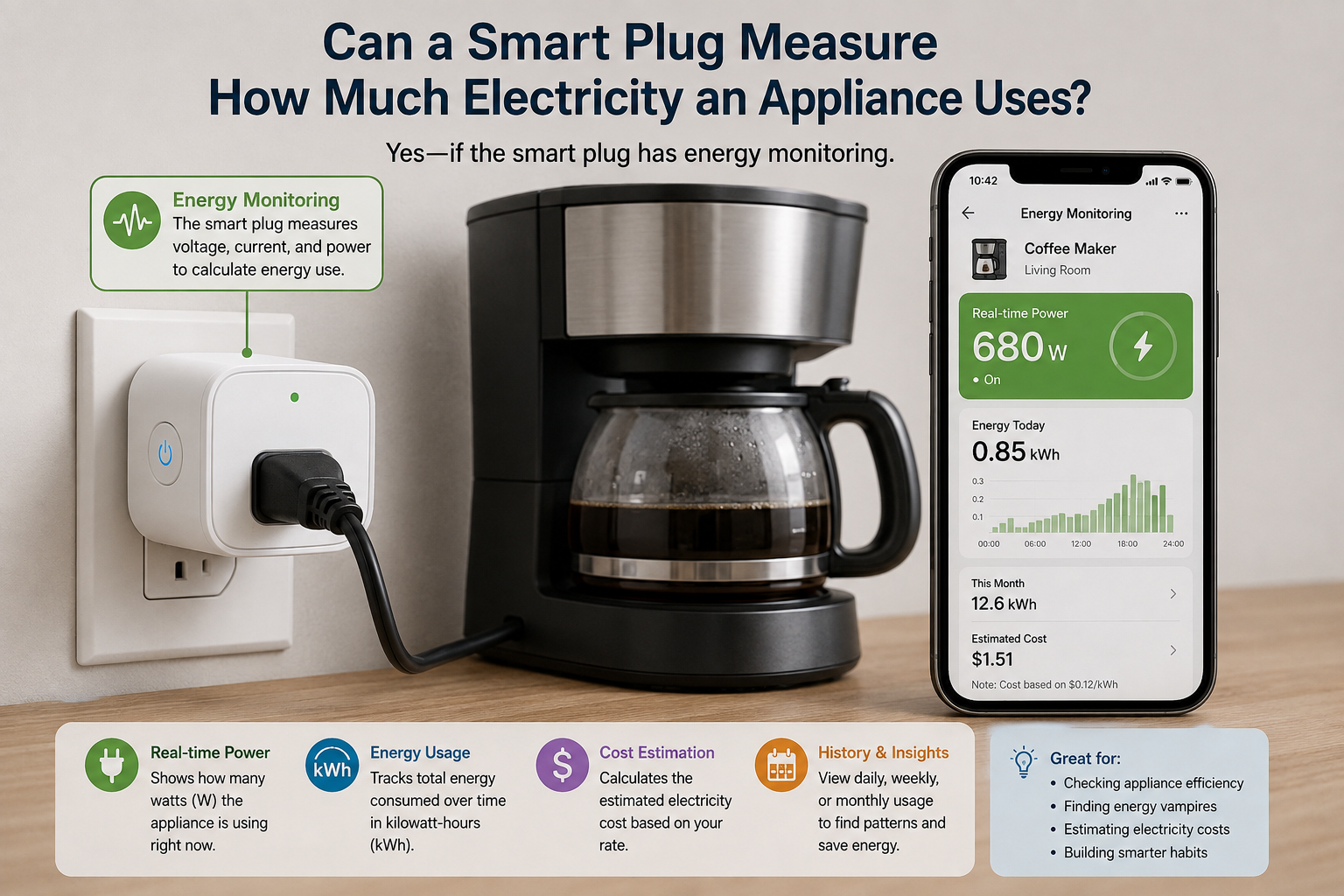
Yes, but not every smart plug can measure electricity usage. A smart plug with built-in energy monitoring can measure an appliance’s electrical consumption and usually report real-time power in watts (W) and accumulated energy in kilowatt-hours (kWh).
That distinction matters because many smart plugs are designed mainly for remote on/off control, scheduling, and automation. Energy-monitoring models contain additional electrical measurement hardware that allows them to track how much power a connected appliance is using.
For example, TP-Link says selected Kasa smart plugs use dedicated measurement hardware to measure voltage, current, and power. Its Tapo energy-monitoring plugs can also provide real-time power readings and historical energy-use information.
Can a Smart Plug Measure How Much Electricity an Appliance Uses?
An energy-monitoring smart plug can measure the electricity consumption of a compatible appliance.
The important word is energy-monitoring.
A basic smart plug may allow you to turn an appliance on or off from an app and create schedules. That doesn’t necessarily mean it knows how much electricity the appliance is consuming.
An energy-monitoring smart plug adds measurement circuitry. Depending on the model, its app may show information such as:
- Current power consumption in watts
- Voltage
- Current in amps
- Cumulative energy consumption in Wh or kWh
- Daily, weekly, or monthly usage
- Estimated electricity cost
For example, TP-Link’s Tapo energy-monitoring documentation describes real-time power readings and energy-usage graphs that can show consumption over different periods.
How to tell if your smart plug measures electricity
Before buying or installing one, look for terms such as:
- Energy monitoring
- Power monitoring
- Real-time power
- Energy consumption
- kWh monitoring
Don’t assume that every product described as a “smart plug” includes these features.
How Does a Smart Plug Measure Electricity?
An energy-monitoring smart plug sits between the wall outlet and the appliance.
When electricity flows through the plug, the internal measurement electronics monitor electrical quantities such as voltage and current. The device can then calculate power consumption and accumulate those measurements over time.
In simple terms:
Power (watts) ≈ voltage × current
For real-world AC measurements, however, accurate power measurement can involve additional factors such as the load’s power factor and the way the device samples the electrical waveform.
The important point for homeowners is that the smart plug isn’t simply guessing based on the appliance’s label. An energy-monitoring model uses electrical measurement hardware to generate its readings.
TP-Link specifically states that its energy-monitoring devices contain a dedicated chip for measuring voltage, current and power.
Some products can then send that information to an app, where you can see current power and accumulated energy.
Emporia, for example, says its Smart Plug measures real-time power in watts and cumulative energy in kWh and reports the information through its energy-management system.
Watts vs. kWh: What’s the Difference?
One of the easiest mistakes to make when reading smart-plug data is confusing watts with kilowatt-hours.
Watts measure power
Watts tell you how quickly an appliance is using electrical energy at a particular moment.
For example, if a device is drawing 100 watts, that is its approximate power demand at that moment.
Kilowatt-hours measure energy
A kilowatt-hour measures how much energy has been consumed over time.
For example, an appliance that continuously uses 100 watts for 10 hours would consume:
100 W × 10 hours = 1,000 Wh = 1 kWh
So a live wattage reading tells you what is happening now, while the accumulated kWh reading tells you how much energy the appliance has used over a period of time.
This is why the kWh reading is particularly useful when you’re trying to understand electricity costs.
Can a Smart Plug Tell You How Much an Appliance Costs to Run?
Yes, it can provide an estimate.
The basic calculation is:
Electricity cost = energy consumed in kWh × your electricity price per kWh
For example, if an appliance uses 4 kWh and your electricity rate is $0.20 per kWh:
4 × $0.20 = $0.80
The estimated running cost would therefore be $0.80.
However, the smart plug’s cost estimate isn’t necessarily identical to your final electricity bill. Your actual bill can include different rates, taxes, fees, time-of-use pricing, or other charges.
The Federal Trade Commission makes a similar point about appliance energy estimates: estimated operating costs are based on assumptions and can differ from what an individual consumer actually pays because usage and local energy prices vary.
For the most useful results, enter the electricity rate that actually applies to your home when the app supports custom pricing.
How Accurate Are Smart Plug Energy Readings?
This is where the answer becomes more nuanced.
Smart plugs can be very useful for household energy monitoring, but their measurements aren’t automatically equivalent to professional-grade electrical metering.
Accuracy varies by:
- Smart-plug model
- Load size
- Type of appliance
- Power factor
- How rapidly the appliance changes its power consumption
- Measurement hardware
- Calibration
- Software and reporting methods
For example, TP-Link states that the energy-monitoring feature on certain Kasa devices has an error of approximately 3–5% and notes that these products aren’t professional power-measurement devices.
Independent research also highlights an important limitation: rapidly varying electronic loads can be difficult for some consumer smart plugs to measure accurately. A 2023 study testing five commercially available energy-monitoring smart plugs found substantial differences in measurement performance, particularly with highly variable loads.
What does that mean in practice?
For everyday questions such as:
- “Does this device use more electricity than I expected?”
- “How much energy does this appliance use overnight?”
- “How much standby power does this equipment consume?”
- “Which of these devices uses more energy?”
an energy-monitoring smart plug can be extremely useful.
But if you need highly precise electrical measurements for professional, billing, research, or electrical-engineering purposes, a consumer smart plug may not be the appropriate instrument.
How to Use a Smart Plug to Measure an Appliance
If you want to measure a plug-in appliance, the basic process is straightforward.
1. Choose an energy-monitoring smart plug
Make sure the product specifically supports energy or power monitoring.
A smart plug that only offers remote control won’t necessarily provide electricity measurements.
2. Check the electrical rating
Before connecting an appliance, check the smart plug’s voltage, current, and maximum-load specifications.
The appliance must be compatible with the plug.
3. Connect the smart plug
Plug the smart plug into the wall outlet and connect the appliance to the smart plug according to the manufacturer’s instructions.
4. Check the real-time power reading
If the model supports live power monitoring, look at its wattage reading while the appliance is operating.
This tells you approximately how much power the appliance is drawing at that moment.
5. Monitor cumulative energy
For a more useful measurement, leave the appliance connected for a representative period and check the accumulated kWh.
This is often more informative than taking a single wattage reading.
6. Calculate the cost
Multiply the measured kWh by your electricity rate.
Cost = kWh × price per kWh
This gives you an estimate of the appliance’s electricity cost during the measurement period.
Which Appliances Can You Monitor With a Smart Plug?
Energy-monitoring smart plugs are particularly useful for compatible plug-in appliances and electronics.
Examples can include:
- Lamps
- Fans
- Televisions
- Computers and monitors
- Gaming equipment
- Routers
- Chargers
- Small kitchen appliances
- Entertainment equipment
- Other appropriately rated plug-in devices
They’re especially useful when an appliance’s actual operating pattern isn’t obvious.
For example, a refrigerator may not consume the same amount of power continuously because its compressor cycles on and off. Measuring over a longer period can therefore give you a more useful picture than looking at one instantaneous reading.
The same principle applies to many modern electronic devices that switch between active, idle, sleep, and standby modes.
Can a Smart Plug Measure Standby Electricity Use?
Yes, if the smart plug can accurately measure the relatively small load.
Many electronic devices continue consuming some electricity while they appear to be turned off or are in standby mode.
An energy-monitoring smart plug can help reveal whether a device is drawing power when you aren’t actively using it.
Instead of guessing, you can look at the measured wattage and then monitor accumulated energy over a longer period.
This can be particularly useful for identifying devices that spend many hours in standby.
Can You Measure a Refrigerator With a Smart Plug?
A compatible energy-monitoring smart plug can be useful for measuring a refrigerator’s energy consumption, but you should consider the appliance’s electrical requirements and the smart plug’s ratings before connecting it.
A refrigerator is also a good example of why longer measurement periods matter.
The compressor doesn’t necessarily run continuously. Its power demand changes as it cycles, so a single instantaneous wattage reading doesn’t represent the refrigerator’s total daily or monthly consumption.
Monitoring accumulated kWh over a representative period gives you a much better picture.
This is also an area where measurement accuracy can be affected by changing loads. Independent testing has found that smart-plug accuracy can vary depending on load behavior.
What Appliances Should You Not Connect to a Smart Plug?
Never assume that an energy-monitoring feature makes a smart plug suitable for every appliance.
Check the manufacturer’s specifications before connecting anything.
Pay particular attention to:
- Maximum current
- Maximum power
- Supported voltage
- Plug/socket type
- Appliance type
- Motor or compressor loads
- Manufacturer restrictions
You should also be cautious with appliances that are hardwired into your home’s electrical system. A plug-in smart meter isn’t the appropriate tool for measuring a permanently wired circuit.
If an appliance exceeds the smart plug’s electrical rating, do not use that smart plug with it.
For unusual, high-power, or hardwired equipment, an appropriately rated electrical monitoring solution may be necessary.
Smart Plug vs. Electricity Meter
A smart plug and a whole-home electricity meter serve different purposes.
| Feature | Energy-monitoring smart plug | Whole-home electricity meter |
|---|---|---|
| Measures one connected appliance | Yes | Not usually at appliance level |
| Measures whole-home consumption | No | Yes |
| Shows real-time power | Many models | Depending on system |
| Tracks kWh | Many models | Yes |
| Estimates appliance cost | Many models | Can estimate whole-home cost |
| Easy to install | Usually | Depends on system |
| Suitable for hardwired circuits | No | Depending on monitoring system |
If your question is “How much electricity does this one appliance use?”, a suitable energy-monitoring smart plug can be a convenient solution.
If your question is “How much electricity does my entire house use?”, you’ll need whole-home or circuit-level monitoring instead.
Do Smart Plugs Actually Save Electricity?
A smart plug doesn’t automatically make an appliance more energy efficient.
Its biggest advantage is visibility and control.
Once you know how much electricity a device consumes, you can make better decisions about how and when you use it.
For example, you might discover that a device consumes more standby power than expected. You could then use a schedule to disconnect it during periods when it isn’t needed—assuming doing so is compatible with the appliance and the smart plug manufacturer’s instructions.
Some energy-monitoring smart plugs also provide scheduling and automation features. TP-Link describes energy monitoring alongside scheduling and timer functions on its smart-plug products.
So the potential savings come from the actions you take after seeing the data—not from the smart plug itself.
Smart Plug Energy Monitoring: What Should You Look For?
If measuring electricity consumption is your main goal, don’t buy a smart plug based only on the word “smart.”
Look for:
Energy monitoring
The product should explicitly state that it measures energy or power consumption.
Real-time wattage
This helps you see how much power an appliance is drawing at a particular moment.
Cumulative kWh
This is one of the most useful measurements for estimating energy costs.
Historical data
Daily, weekly, or monthly data makes it easier to identify patterns.
Appropriate electrical ratings
Make sure the plug is designed for your appliance and your electrical system.
Measurement accuracy information
If accuracy matters to you, check whether the manufacturer publishes a measurement-accuracy specification.
Frequently Asked Questions
Does every smart plug measure electricity?
No. Some smart plugs primarily provide remote control, scheduling, and automation. Look specifically for an energy-monitoring feature.
Can a smart plug show watts?
Yes, if it has power monitoring. Energy-monitoring models can display real-time power consumption in watts.
Can a smart plug show kWh?
Many energy-monitoring smart plugs can. Check the individual model’s specifications because features differ between products.
Can a smart plug calculate electricity costs?
Many can provide an estimated cost when you provide an electricity rate. The result should be treated as an estimate rather than an exact utility bill.
Are smart plug energy readings accurate?
They can be useful, but accuracy varies. Manufacturer specifications and independent testing show that performance depends on the particular plug and the type of load being measured.
Is a smart plug better than an appliance’s wattage label?
They answer different questions. A label can provide rated or estimated information, while a smart plug can measure the appliance’s actual electrical behavior during your use.
For major appliances, official energy labels can also provide useful standardized consumption information. The FTC notes that EnergyGuide labels provide energy-use and operating-cost estimates for covered appliances.
Does measuring electricity reduce the electricity bill?
No—not by itself. Monitoring gives you information. Savings come from changing usage, reducing unnecessary runtime, improving efficiency, or replacing inefficient equipment when appropriate.
Final Verdict: Can a Smart Plug Measure Electricity Usage?
Yes, an energy-monitoring smart plug can measure how much electricity a compatible appliance uses.
The key is choosing a model that specifically includes energy monitoring rather than assuming every smart plug has a built-in meter.
For everyday home energy tracking, the most useful measurements are:
- Watts for current power consumption
- kWh for accumulated energy consumption
- Cost estimates for understanding potential electricity expenses
A smart plug can be an inexpensive and convenient way to discover which plug-in devices consume the most energy. Just remember that consumer smart plugs have limitations, and their readings shouldn’t automatically be treated as professional-grade measurements.
If your goal is simply to understand what an appliance costs to run and how its consumption changes over time, an energy-monitoring smart plug can be a very practical tool.