Matter Energy Management Explained: What It Means for Your Smart Home
Smart homes are becoming more than a collection of connected lights, locks, cameras, and thermostats. Increasingly, homeowners want their smart-home systems to understand how much electricity the home is using, when energy is being consumed, where that energy comes from, and when certain devices should operate.
This is where Matter energy management becomes important.
Matter is an open smart-home standard designed to help compatible devices communicate across different smart-home ecosystems. Its energy-management capabilities are designed to take that interoperability a step further by allowing supported devices to report energy information and, in more advanced scenarios, participate in coordinated energy-management strategies.
The technology has developed considerably since Matter first introduced energy-reporting capabilities. Matter 1.3 established important foundations for energy reporting and management, Matter 1.4 expanded support to devices such as solar systems, batteries, heat pumps, and water heaters, and Matter 1.5 added standardized information for energy pricing, tariffs, and grid carbon intensity.
So what does all this mean for your home?
In simple terms, Matter energy management is about helping compatible smart-home devices understand and respond to energy information so your home can monitor and potentially optimize electricity use more intelligently.
Let’s break down how it works and what homeowners should know.
What Is Matter Energy Management?
Matter energy management is a set of capabilities within the Matter smart-home standard that allows compatible devices and energy-management systems to exchange information about electrical consumption, production, forecasts, preferences, and other energy-related conditions.
The goal isn’t simply to tell you that a washing machine is consuming electricity.
A more advanced system can use information about:
- Current power consumption
- Energy usage
- Expected energy consumption
- Energy production
- Solar generation
- Battery availability
- EV charging requirements
- Electricity pricing
- Tariff schedules
- Grid conditions
- Carbon-intensity information
- User energy preferences
to make smarter decisions about when and how devices operate.
The Connectivity Standards Alliance describes Matter’s energy-management framework as supporting communication between energy-management systems and energy-smart appliances. Matter’s specifications include capabilities for managing power draw, sharing power forecasts, and expressing energy preferences.
For a homeowner, the important distinction is this:
Energy monitoring tells you what is happening. Energy management can help determine what should happen next.
Matter Energy Reporting vs. Energy Management
These two concepts are related but not identical.
Energy reporting
Energy reporting is primarily about measuring and communicating information.
For example, a compatible device might report:
“I am currently using 1,500 watts.”
Or it could provide information about accumulated electrical energy consumption.
This information can be displayed or used by a smart-home platform.
Matter introduced electrical power and energy measurement capabilities that allow compatible devices to provide information such as power consumption and other electrical measurements.
Energy management
Energy management goes further.
Instead of simply reporting that an appliance is consuming electricity, an energy-management system could potentially use information about the device’s expected operation and energy conditions to determine whether its operation should be adjusted.
For example:
You start a washing machine at 2:00 PM and tell the system that it can finish anytime before 7:00 PM.
If the home has solar panels producing plenty of electricity during the afternoon, the energy-management system could use that information when deciding when the appliance should run.
This is the basic idea behind flexible energy consumption.
The appliance still completes its job, but its energy usage can potentially be shifted to a more suitable time.
How Does Matter Energy Management Work?
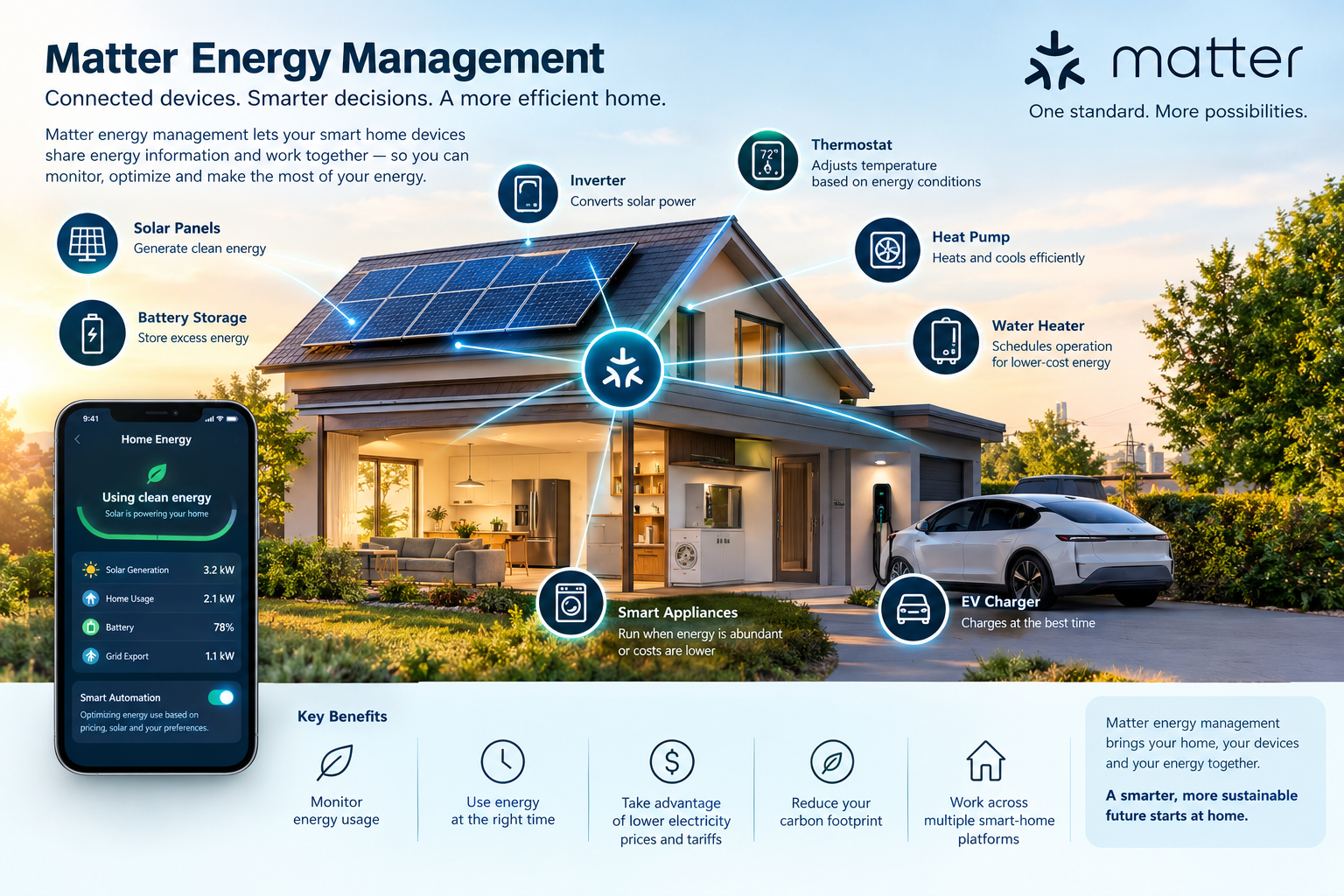
A Matter-based energy-management setup can involve several components.
1. Energy-producing devices
These could include:
- Solar panels
- Solar inverters
- Solar-plus-battery systems
- Home battery storage
Matter 1.4 expanded energy-management support to solar and battery-related device types.
2. Energy-consuming devices
These can include:
- Major appliances
- EV chargers
- Heat pumps
- Water heaters
- HVAC equipment
- Other energy-smart devices
3. Energy-management systems
An energy-management system can collect information from compatible devices and coordinate energy-related actions.
The Matter specification includes a Device Energy Management capability designed to allow an energy-management system to manage the power draw of an energy-smart appliance.
4. Smart-home platforms
Your smart-home ecosystem or controller can provide the interface through which you see and manage compatible devices.
Matter itself is not a replacement for every smart-home platform. It is an interoperability standard that allows compatible products to communicate using a common framework.
Matter can operate across technologies including Wi-Fi, Thread, and Ethernet, while Bluetooth Low Energy can be used during setup.
Why Does Matter Energy Management Matter for Homeowners?
Traditional smart-home automation usually focuses on convenience.
For example:
- Turn the lights on when motion is detected.
- Lock the doors at night.
- Adjust the thermostat when you leave.
- Turn on a fan when a room gets warm.
Energy management introduces another dimension:
Use energy intelligently.
Instead of only asking whether a device is available, the system can potentially consider when electricity should be used.
That matters because electricity consumption is not necessarily equally valuable or costly at every moment.
Depending on your electricity plan and local energy system, prices may vary according to time, tariffs, or other conditions.
Matter 1.5 introduced a standardized electrical energy tariff device type designed to communicate real-time and forecasted pricing, tariff, and grid-carbon information to compatible devices.
That creates opportunities for smarter automation.
Matter and Solar Power
Solar energy is one of the most interesting applications for Matter energy management.
Imagine a home with:
- Rooftop solar panels
- A solar inverter
- A battery
- An EV
- A smart water heater
- A washing machine
- A heat pump
Without coordination, each device may operate independently.
With compatible energy-management capabilities, the home could potentially coordinate these loads around available solar production.
For example, if your solar system is producing more electricity than the home currently needs, an energy-management system could potentially prioritize flexible loads.
Instead of exporting all excess energy immediately, the home might use some of that electricity to:
- Charge a battery
- Heat water
- Charge an EV
- Run a flexible appliance
The exact behavior depends on the equipment, software, utility rules, local regulations, and ecosystem support.
Matter provides the standardized communication framework; it does not automatically make every device capable of every automation.
Matter and Home Batteries
Home batteries can make energy management considerably more interesting.
A battery can store electricity and make it available later.
For example, a homeowner with solar panels might generate significant electricity during the afternoon. Some of that energy could be stored in a home battery and used later.
Matter 1.4 expanded support for battery energy-management scenarios, including battery storage systems capable of supplying energy to the home or potentially the grid.
A future-oriented home-energy strategy might consider:
- How much solar energy is currently being generated
- How much electricity the home is using
- How much energy remains in the battery
- Expected solar production
- Expected household demand
- Electricity pricing
- User preferences
The system can then make decisions based on those conditions.
Matter and Electric Vehicle Charging
EV charging is another major use case.
Charging an electric vehicle can represent a significant electrical load.
If an EV is plugged in at 6 PM, that doesn’t necessarily mean it needs to consume maximum power immediately.
Suppose you need the vehicle by 7 AM the next morning.
A compatible energy-management system could potentially use your charging preference, electricity conditions, and other energy information to determine an appropriate charging schedule.
Matter 1.4 expanded EVSE capabilities with user-defined charging preferences, including specifying when the user wants the vehicle charged.
This introduces an important concept:
Flexible energy demand
Some electrical loads are flexible.
You may not care whether your car charges at 8 PM or 11 PM, provided it is ready when you need it.
The same can apply to:
- Dishwashers
- Washing machines
- Water heaters
- Pool equipment
- Battery charging
- Some HVAC operations
Matter’s energy-management capabilities are intended to help compatible devices participate in these kinds of coordinated scenarios.
Matter and Smart Water Heaters
Water heaters can also be useful energy-management devices.
You generally don’t need the water heater to operate at maximum output every minute of the day.
Matter 1.4 added support for electric water heaters, including capabilities related to temperature or hot-water levels, scheduling, and temporary boost operation.
For example, a smart system could potentially maintain hot-water availability while adjusting heating behavior according to a household’s schedule and energy conditions.
A temporary boost could then be used when extra hot water is needed.
This is a good example of how energy management doesn’t necessarily mean sacrificing comfort.
The objective can instead be to coordinate energy usage while maintaining the service the homeowner actually needs.
Matter and Heat Pumps
Heat pumps can also participate in energy-management strategies.
Heating and cooling can represent substantial household energy consumption.
Matter 1.4 introduced energy-management support for heat pumps, including scenarios in which energy use can be shifted toward different periods.
For example, a system could potentially pre-condition a home during a favorable period rather than relying entirely on higher-demand periods later.
However, comfort requirements remain important.
An energy-management system should not simply reduce heating or cooling without considering the homeowner’s preferences.
This is one reason user-defined energy preferences are important within the Matter energy-management framework.
Matter 1.5 Added Energy Pricing and Grid Carbon Information
One of the more important developments in Matter energy management came with Matter 1.5.
Matter 1.5 introduced capabilities for sharing standardized information about:
- Energy prices
- Tariffs
- Grid carbon intensity
- Real-time energy conditions
- Forecasted energy conditions
The Connectivity Standards Alliance says compatible devices can use this information to estimate energy costs and carbon impact or adjust operation according to preferences and tariff schedules.
This is significant because smart-home energy management can move beyond simply asking:
“How much electricity am I using?”
It can potentially ask:
“When should I use electricity?”
That is a much more powerful question.
A Simple Real-World Example
Consider a home with rooftop solar, a battery, an EV, and several smart appliances.
At noon:
- Solar production is high.
- Household demand is moderate.
- The battery is partially charged.
- The EV is plugged in.
- The washing machine has a flexible operating window.
The energy-management system can potentially coordinate these loads.
For example:
Solar production → household demand → battery charging → flexible appliances → EV charging
The exact priority depends on the homeowner’s settings and equipment.
Later in the evening, solar production falls.
The system can then use stored energy or adjust flexible loads according to the configured strategy.
This is the basic concept behind a more intelligent home energy-management system.
Does Matter Automatically Lower Your Electricity Bill?
No.
This is one of the most important things to understand.
Buying a Matter-certified device does not automatically guarantee lower electricity bills.
Matter is an interoperability standard. Energy savings depend on:
- The devices you own
- Whether they support the relevant energy features
- Your smart-home platform
- Your electricity tariff
- Your usage habits
- Your automation settings
- Your home’s insulation and HVAC efficiency
- Solar production
- Battery capacity
- Local utility programs
- How the devices actually implement Matter features
A smart plug that reports energy usage may help you understand consumption, but it does not automatically reduce that consumption.
Likewise, a Matter-compatible EV charger does not necessarily mean your EV will automatically charge at the cheapest possible time.
The required functionality must be supported by the device and ecosystem.
Matter Energy Management vs. a Traditional Energy Monitor
These technologies can complement each other.
Traditional energy monitor
An energy monitor primarily helps you answer:
- How much electricity am I using?
- Which circuit is consuming power?
- How does usage change throughout the day?
Matter energy management
Matter can provide a standardized way for supported devices to participate in a broader smart-home energy system.
That can involve:
- Energy measurements
- Energy forecasts
- Energy preferences
- Device control
- Flexible operating schedules
- Energy pricing
- Tariff information
- Grid-related information
So an energy monitor is primarily about visibility, while energy management adds the possibility of coordination and automation.
What Devices Can Benefit From Matter Energy Management?
The Matter ecosystem continues to evolve, but energy-related device categories and capabilities include several important areas.
Solar systems
Solar-related Matter capabilities can cover equipment such as inverters and solar arrays.
Batteries
Home battery systems can participate in energy-management scenarios.
EV chargers
EV charging can be coordinated around user-defined charging requirements.
Heat pumps
Heat pumps can potentially adjust energy consumption according to schedules and energy-management conditions.
Water heaters
Water heaters can support scheduling and energy-management features.
Smart appliances
Energy-smart appliances can potentially communicate energy requirements and participate in flexible scheduling.
Thermostats
Thermostat capabilities include scheduling and preset modes, while newer Matter releases have continued improving context-aware thermostat behavior.
Matter 1.6, released in June 2026, introduced Thermostat Suggestions, allowing ecosystems to send recommendations that thermostats can evaluate against user preferences and current context.
Matter Energy Management Is Not the Same as a Smart Meter
These terms can easily be confused.
A smart meter is generally provided as part of a utility’s electricity infrastructure and measures electricity consumption or other electrical information for billing and grid purposes.
A Matter device is a consumer or building device that communicates using the Matter standard.
An energy-management system coordinates energy-related devices and information.
A smart plug or energy monitor can measure electrical consumption for a particular device or circuit.
These systems can work together, but they perform different functions.
What About Electricity Tariffs?
Electricity tariffs are particularly important for energy optimization.
Suppose your electricity provider uses different pricing periods.
You may have a reason to avoid running certain flexible appliances during expensive periods.
Matter 1.5’s energy tariff capabilities provide a standardized mechanism for energy pricing and tariff information to be shared with compatible devices.
This could eventually allow more sophisticated automations.
For example:
High-cost period → delay flexible appliance
or:
Lower-cost period → begin EV charging
The important word is flexible.
Not every electrical load should be shifted.
A refrigerator, medical device, security system, or other essential equipment may need to operate regardless of electricity pricing.
Good energy management therefore needs to distinguish between essential and flexible loads.
Can Matter Work With Multiple Smart-Home Platforms?
One of Matter’s major purposes is interoperability.
Matter is designed as an open smart-home standard, allowing certified devices to work with Matter-enabled ecosystems rather than forcing every device into one proprietary communication system.
Matter also supports multi-admin scenarios, allowing devices to be shared across ecosystems.
However, there is an important distinction between:
“The device supports Matter.”
and:
“My preferred ecosystem supports every energy feature this Matter device provides.”
Those are not necessarily the same thing.
Manufacturers and ecosystem providers still need to implement and support particular Matter capabilities.
The Connectivity Standards Alliance explicitly notes that implementation timelines and product availability can vary by manufacturer and ecosystem.
What You Need to Build a Matter Energy Management System
You don’t necessarily need to replace every smart device in your home.
A practical setup might include:
1. Matter-compatible devices
Look for products that specifically support the Matter features you need.
Don’t rely solely on the Matter logo.
Check the product specifications.
2. A compatible smart-home controller
You need an ecosystem or controller capable of managing the Matter devices and relevant functionality.
3. A suitable home network
Matter devices can use Wi-Fi, Thread, or Ethernet, depending on the device.
4. Energy-producing equipment
If you have solar panels or a battery, check whether your equipment supports the relevant Matter energy-management capabilities.
5. Appropriate automations
Automation is where much of the value appears.
For example:
- Charge the EV during a preferred period.
- Run flexible appliances when solar production is high.
- Heat water according to household schedules.
- Coordinate battery usage.
- Adjust energy-consuming devices based on user preferences.
What Should You Look for When Buying Matter Energy Devices?
If energy management is your goal, don’t buy a device simply because it says “Matter.”
Check for the specific functionality.
Look for information about:
- Energy measurement
- Power measurement
- Energy reporting
- Device Energy Management
- Energy preferences
- Flexible scheduling
- EV charging preferences
- Solar integration
- Battery integration
- Tariff support
- Supported Matter version
- Supported smart-home ecosystems
- Firmware update policy
Also verify whether the device supports the exact Matter feature through your preferred smart-home platform.
Matter Energy Management Limitations
The technology is promising, but there are still practical limitations.
Not every Matter device supports energy management
Matter is a broad standard covering many smart-home categories.
A Matter light bulb doesn’t automatically become an energy-management device.
Feature support varies
Two Matter-certified products can support different Matter capabilities.
Ecosystem support matters
A device may technically support a Matter feature that isn’t fully exposed through your preferred smart-home app.
Hardware matters
Some energy-management features require appropriate electrical measurement hardware, power electronics, sensors, or controls.
Software alone cannot turn every appliance into a flexible energy load.
Local utility rules matter
Energy pricing, demand-response programs, solar export rules, and grid programs vary by region.
Savings aren’t guaranteed
The technology provides opportunities for optimization, but actual savings depend on how the system is configured and used.
Is Matter Energy Management Worth It?
For homeowners who are interested only in basic smart-home control, energy management may not be an immediate priority.
But it becomes considerably more relevant if your home has:
- Solar panels
- Home battery storage
- An EV
- A heat pump
- Electric water heating
- Multiple smart appliances
- Time-of-use electricity pricing
- A desire to monitor household electricity usage
The more flexible electrical loads you have, the more opportunities there are for coordinated energy management.
A home with only a few smart lights has limited energy-management potential.
A home with solar, batteries, an EV, HVAC equipment, water heating, and flexible appliances has many more opportunities.
The Future of Matter Energy Management
Matter’s energy-management capabilities are still developing.
Matter 1.3 established important energy-reporting and management foundations.
Matter 1.4 expanded the ecosystem to include additional energy-related devices such as solar, batteries, heat pumps, and water heaters.
Matter 1.5 added standardized energy pricing, tariff, and grid-carbon information.
Matter 1.6, released in June 2026, focused on broader smart-home improvements rather than adding another major energy-device category, but it introduced Thermostat Suggestions that can improve context-aware thermostat control and respect user preferences.
The Alliance is also working with the OpenADR Alliance on grid-connected residential energy management. That collaboration is intended to help connect smart-home devices and energy-management systems with grid demand-response use cases.
This points toward a future in which the smart home doesn’t just react to commands.
It can potentially react to:
- Household demand
- Energy availability
- Electricity prices
- Solar production
- Battery status
- EV requirements
- Grid conditions
- User preferences
Frequently Asked Questions
What is Matter energy management?
Matter energy management is a collection of Matter capabilities that allow compatible devices and energy-management systems to exchange information about electrical consumption, production, forecasts, preferences, pricing, and other energy-related conditions.
Does Matter monitor electricity usage?
Supported Matter devices can report electrical power and energy measurements. However, not every Matter device includes energy-measurement hardware or supports energy reporting.
Can Matter reduce my electricity bill?
Matter can enable automations that may help optimize electricity usage, but it does not guarantee savings. Actual results depend on your devices, electricity plan, automation settings, energy habits, and local conditions.
Can Matter manage solar panels?
Matter 1.4 expanded energy-management support to solar-related devices such as inverters and solar systems. Actual consumer functionality depends on product and ecosystem implementation.
Can Matter work with home batteries?
Yes, Matter 1.4 expanded support for battery-related energy-management scenarios. Compatible battery systems can potentially participate in coordinated home-energy strategies.
Can Matter optimize EV charging?
Matter 1.4 enhanced EVSE capabilities, including user-defined charging preferences. Whether a particular EV charger can perform a particular automation depends on its implementation and the ecosystem controlling it.
Does Matter replace my smart-home platform?
No. Matter is an interoperability standard rather than a complete smart-home platform. It allows compatible devices to communicate with supported ecosystems and controllers.
What is the difference between Matter and an energy-management system?
Matter provides standardized communication capabilities. An energy-management system uses information from compatible devices and other sources to coordinate energy use.
Is Matter energy management available everywhere?
The Matter standard is global, but actual device capabilities, ecosystem support, utility programs, electricity tariffs, and product availability vary by region.
Final Takeaway
Matter energy management is an important evolution of the smart home because it moves connected devices beyond simple remote control toward coordinated energy use.
The technology can help compatible devices communicate information about power consumption, energy usage, forecasts, preferences, solar generation, batteries, EV charging, and—through newer Matter capabilities—energy pricing and grid carbon information.
The biggest potential benefit isn’t simply knowing how many watts an appliance uses.
It’s being able to coordinate when energy is used.
Imagine a home where solar production, battery storage, EV charging, water heating, HVAC, and flexible appliances can work together rather than operating independently.
That is the direction Matter energy management is helping the smart-home industry move toward.
However, homeowners should keep expectations realistic. A Matter-certified device isn’t automatically an energy-saving device, and Matter support alone doesn’t guarantee compatibility with every energy-management feature.
When shopping for new equipment, look beyond the Matter logo and check the specific energy capabilities, supported Matter version, ecosystem compatibility, and automation features.
For homes with solar panels, batteries, EVs, electric heating, smart appliances, or time-based electricity pricing, these capabilities could become increasingly useful as manufacturers and smart-home platforms implement more of Matter’s energy-management features.
In other words, the future smart home may not simply ask:
“What should this device do?”
It may increasingly ask:
“When is the smartest time for this device to do it?”