What Is a Virtual Power Plant and Can Homeowners Join One?
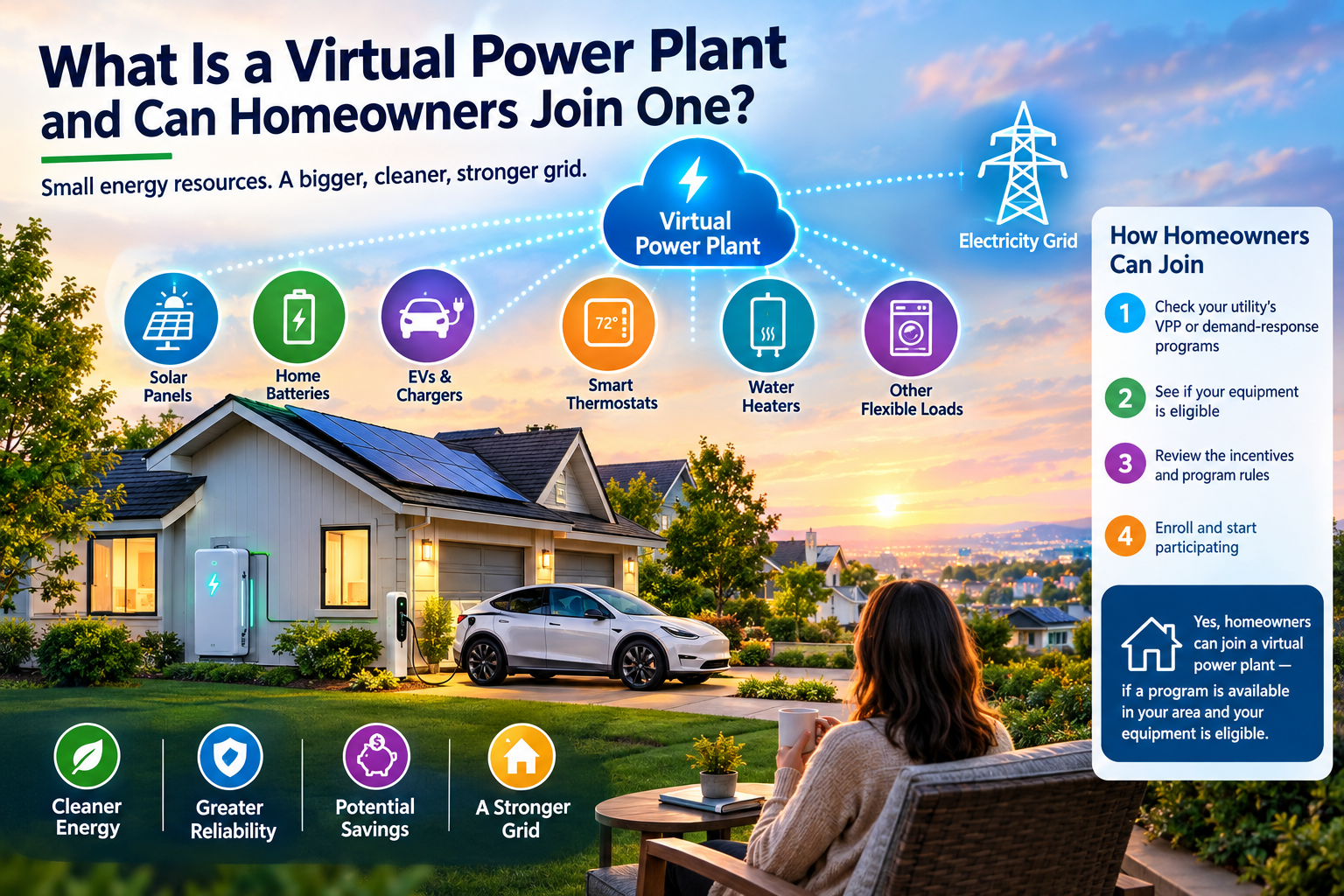
A virtual power plant, or VPP, is a network of homes, batteries, electric vehicles, solar systems, smart thermostats, water heaters, and other energy devices that can be coordinated as one large energy resource.
Instead of building one enormous power plant, a utility or energy company can coordinate thousands of smaller resources spread across different homes and businesses. Software connects these resources and manages when they use, store, or sometimes supply electricity.
For homeowners, this raises an important question:
Can you actually join a virtual power plant and get paid for helping the grid?
In many places, the answer is yes—but participation depends heavily on where you live, your utility, the equipment in your home, and the specific VPP program available in your area.
Some programs use home batteries to send stored electricity to the grid during periods of high demand. Others can coordinate EV charging, smart thermostats, water heaters, or other flexible loads. Participants may receive bill credits, payments, or other incentives in exchange for allowing their equipment to respond during designated grid events.
This guide explains how virtual power plants work, what homeowners need to participate, what you might receive, and what to consider before enrolling.
What Is a Virtual Power Plant?
A virtual power plant is essentially a network of small energy resources controlled or coordinated through software.
A traditional power plant generates electricity at a centralized location. A VPP takes a different approach.
Imagine 10,000 homes in a region each have one or more of the following:
- Solar panels
- Home batteries
- Electric vehicles
- Smart EV chargers
- Smart thermostats
- Electric water heaters
- Heat pumps
- Other controllable appliances or flexible electrical loads
Individually, each home represents a relatively small amount of energy capacity.
Collectively, however, thousands of homes can provide a significant amount of flexible energy.
The VPP platform coordinates those resources so they can respond to grid conditions.
For example, if electricity demand becomes unusually high on a hot afternoon, a VPP could potentially:
- Reduce air-conditioning demand through participating smart thermostats.
- Delay EV charging.
- Reduce the electricity used by participating water heaters.
- Discharge energy from home batteries.
- Coordinate other flexible loads.
The result is a collection of distributed devices behaving, from the grid’s perspective, somewhat like a larger power resource.
That is why it is called a virtual power plant.
How Does a Virtual Power Plant Work?
The basic process is easier to understand with a simple example.
Imagine a neighborhood with 1,000 participating homes.
Suppose 300 homes have batteries, 400 have smart thermostats, 200 have EV chargers, and many have other connected devices.
During normal conditions, these devices operate according to the homeowners’ normal preferences.
Then the grid experiences a period of high demand.
The VPP operator receives a signal that additional flexibility is needed.
The software can then coordinate participating devices according to the rules of the program.
Some batteries might discharge.
Some EV charging might be shifted to a later time.
Some thermostats might make small temporary adjustments.
Some water heaters might reduce or postpone electricity consumption.
No individual household needs to behave like a traditional power plant.
Instead, thousands of small changes can be combined.
This coordination is one of the central ideas behind VPPs.
What Devices Can Participate in a VPP?
You don’t necessarily need solar panels to participate.
The equipment accepted by a VPP depends on the specific program, but common distributed energy resources include:
1. Home Batteries
Home batteries are one of the most obvious VPP resources.
A battery can store electricity and later discharge some of that energy when the grid needs additional supply.
For a homeowner, this can create an opportunity to receive compensation while still retaining some stored energy for backup.
Many current VPP programs specifically use residential batteries.
2. Rooftop Solar
Solar panels can contribute to a VPP, especially when paired with battery storage.
Solar can generate electricity during the day, while a battery can store some of that energy for later use.
A VPP may then coordinate the battery during periods when the grid needs additional capacity.
3. Electric Vehicles
An EV contains a large battery, which creates another potential source of flexibility.
At a minimum, a VPP can coordinate when the vehicle charges.
Some advanced programs can potentially use stored EV energy to support the home or grid, depending on the vehicle, charger, utility, and program.
This is sometimes described as vehicle-to-home or vehicle-to-grid functionality.
However, homeowners should not assume that every EV or charger can participate in this way.
Compatibility matters.
4. Smart Thermostats
A smart thermostat can be a VPP resource because heating and cooling demand can sometimes be shifted for short periods.
For example, during a peak-demand event, a participating program might make a small temperature adjustment.
The goal is not necessarily to turn off a home’s heating or cooling system completely.
Instead, many demand-response approaches make relatively small adjustments across many homes.
5. Electric Water Heaters
Electric water heaters can also provide flexibility.
Because hot water can be stored in the tank, the heating cycle doesn’t necessarily need to occur at exactly the same time as electricity demand.
A VPP can potentially shift water-heating activity to another period when electricity demand is lower.
6. Heat Pumps and Other Flexible Loads
Heat pumps, pool pumps, building controls, and other connected equipment can also serve as distributed energy resources.
The important factor is whether the device can safely and reliably respond to a program’s control signals.
Why Do Utilities Want Virtual Power Plants?
Electricity demand changes throughout the day.
There can be periods when millions of customers use electricity simultaneously.
Hot weather is a classic example.
On a very hot afternoon, large numbers of households may run air conditioners at the same time.
That can put additional pressure on the electrical system.
Traditional grid planning can involve building or maintaining additional generation, transmission, and distribution infrastructure to handle these conditions.
VPPs offer another tool: use existing customer-owned resources more intelligently.
DOE describes VPPs as a way to provide grid flexibility, resilience, and reliability by coordinating distributed resources. The agency also identifies peak demand, distribution congestion, and increasing electrification as important reasons VPPs are receiving greater attention.
What Are the Benefits of Joining a Virtual Power Plant?
For homeowners, the biggest potential benefits generally fall into several categories.
Potential Financial Incentives
Many VPP programs compensate participating customers.
Depending on the program, compensation might come as:
- Monthly bill credits
- Annual bill credits
- Enrollment payments
- Performance payments
- Payments based on energy delivered
- Payments based on available capacity
- Other incentives
There is no single standard VPP payment.
For example, current utility-linked Tesla programs show significantly different compensation structures. Some use annual bill credits, while others use payments based on battery performance or capacity.
That means you should evaluate the actual program available to your home rather than relying on a general VPP earnings estimate.
Supporting Grid Reliability
A VPP can help the electrical system respond when demand is high.
Instead of relying only on large centralized power stations, grid operators and utilities can use distributed resources that are already installed in homes.
This can become increasingly useful as electricity demand grows.
Making Better Use of Home Energy Equipment
If you already own a battery, EV, solar system, or smart device, a VPP may allow that equipment to provide an additional service.
Instead of simply sitting in your garage or operating only for your household, the equipment can potentially become part of a larger coordinated energy resource.
Maintaining Backup Energy
Battery VPP programs often include settings designed to preserve some battery capacity for the homeowner.
However, the exact reserve requirements vary by program.
For example, Tesla’s current programs describe VPP backup-reserve settings that limit how far a participating Powerwall can discharge during grid events.
This is an important feature to investigate before enrolling because backup-power requirements can be different from one program to another.
Do You Need Solar Panels to Join a VPP?
Not always.
This is one of the most important misconceptions about virtual power plants.
A VPP can use different types of distributed energy resources.
Depending on the program, participation may be possible with:
- A home battery
- An EV
- An EV charger
- A smart thermostat
- An electric water heater
- Solar plus battery
- Other compatible equipment
However, some specific programs require a particular technology.
For example, a battery-focused program may only accept customers with an eligible battery system.
So instead of asking only:
“Do I have solar?”
ask:
“Does my utility offer a VPP or demand-response program that accepts the equipment I already own?”
That question can lead to a much more useful answer.
Can Homeowners Really Join a Virtual Power Plant?
Yes, homeowners can participate in VPP programs where residential participation is offered.
The U.S. Department of Energy specifically describes VPP participation models that enroll residential distributed-energy-resource owners.
Current programs demonstrate that this is already happening rather than being purely a future concept.
For example, Tesla currently lists VPP programs across multiple U.S. utility territories for eligible Powerwall owners. Depending on the location, customers may enroll through the Tesla app or through a utility or program partner.
However, availability is highly location-dependent.
You may have a battery that technically supports VPP operation but still have no available program in your utility territory.
How Can You Find a VPP Program Near You?
The first place to check is your electric utility’s website.
Search for terms such as:
- Virtual power plant
- VPP
- Battery program
- Demand response
- Bring your own battery
- Bring your own device
- Battery incentive
- Smart thermostat program
- EV charging program
- Grid services
You can also check the manufacturer’s app for your energy equipment.
For example, Tesla says eligible Powerwall owners can find VPP information through the Tesla app in regions where participating programs are available.
If you have a battery from another manufacturer, check its official app and program information.
What Information Will You Need to Enroll?
A VPP program may ask for information such as:
- Your utility name
- Utility account number
- Service address
- Equipment model
- Battery or inverter information
- Interconnection information
- Contact details
- Permission to participate in demand-response events
Requirements vary.
Some programs may require your battery to have an approved interconnection agreement.
Others may restrict participation based on your electricity rate or whether you are already enrolled with another aggregator.
For example, current Tesla VPP programs show different eligibility requirements depending on the utility territory.
What Happens After You Join?
Once you’re enrolled, the VPP operator or utility monitors grid conditions and determines when participating resources are needed.
You may receive notifications before an event, depending on the program.
During an event, your equipment may respond automatically.
For a battery program, that might mean discharging some stored energy.
For an EV program, it might mean delaying charging.
For a thermostat program, it could mean temporarily adjusting heating or cooling demand.
After the event, the equipment generally returns to its normal operating behavior according to the program’s rules.
The exact event frequency, duration, notification process, and customer control vary considerably.
Will a VPP Take Control of Your Home?
This is one of the most important questions to ask before enrolling.
A VPP doesn’t necessarily mean someone has unrestricted control over your entire home.
Instead, you typically authorize a particular program to manage a specific eligible device or energy resource according to an agreement.
For example, a battery VPP might have permission to discharge your battery during qualifying grid events.
A thermostat program might be allowed to make temporary temperature adjustments.
The agreement should explain:
- Which device can be controlled
- When it can be controlled
- How frequently events can occur
- How long events can last
- What minimum battery reserve is maintained
- Whether you can opt out
- How compensation is calculated
- What happens if the equipment doesn’t respond
- How your data is used
Read these terms before enrolling.
Can You Opt Out of VPP Events?
The answer depends on the program.
Some programs provide opt-out mechanisms, while others may have specific participation requirements.
Never assume that every VPP follows the same rules.
Check the program agreement for:
- Event notification requirements
- Opt-out limits
- Penalties, if any
- Minimum participation requirements
- Backup reserve settings
- Maximum number of events
- Maximum event duration
These details can matter more than the headline incentive.
How Much Money Can a Homeowner Make From a VPP?
There is no universal amount.
Your potential compensation can depend on:
- Your utility
- Your location
- Battery size
- Battery power output
- Number of events
- Program design
- Performance
- Enrollment incentives
- Electricity-market conditions
- Equipment eligibility
Current VPP programs illustrate how widely compensation can differ.
For example, Tesla lists a program with SRP in Arizona offering up to $264 per Powerwall annually in energy bill credits, while its PGE program lists incentives of up to $275 per year per Powerwall. Other programs use different formulas, such as payments based on kilowatts delivered or seasonal performance.
Therefore, avoid judging a VPP based only on another homeowner’s earnings.
The program available in your area is what matters.
Does Joining a VPP Reduce Your Electricity Bill?
It can, but the effect depends on the program.
A VPP may provide direct bill credits or other financial incentives.
Separately, technologies such as batteries, solar, smart thermostats, and EV charging can change when and how much electricity a home draws from the grid.
RMI notes that participating customers can potentially save money through incentives and better control of electricity usage, while VPPs can also provide broader system-level cost benefits.
But participation does not automatically guarantee lower total household energy costs.
If you are considering purchasing an expensive battery solely to join a VPP, calculate the economics separately.
Consider:
Equipment cost + installation + financing + maintenance − incentives − energy savings − VPP compensation
A VPP incentive should generally be treated as one component of the overall financial calculation rather than the only reason to buy equipment.
What Are the Potential Downsides?
VPPs can provide benefits, but homeowners should also understand the trade-offs.
1. Your Equipment May Be Used During Grid Events
If you enroll a battery, some of its stored energy may be discharged when the program calls an event.
That may reduce the amount of energy available for your home at that moment.
2. Compensation Isn’t Guaranteed to Be the Same Everywhere
VPP programs are location-specific.
A program in one state may offer a completely different incentive from a program in another state.
3. Equipment Compatibility Matters
Having a smart device doesn’t automatically mean it can participate.
The program may require a specific manufacturer, model, communication system, inverter, or software platform.
4. Program Rules Can Change
Utilities and regulators can modify programs over time.
Always check the current program agreement rather than relying on an old article or social media post.
5. Privacy and Data Should Be Considered
Connected energy devices can generate information about electricity use and equipment operation.
Before joining, review the provider’s privacy policy and understand what information is collected, how it is used, and which companies receive it.
Is a VPP the Same as Net Metering?
No.
Net metering generally concerns how electricity generated by a customer’s system—often rooftop solar—is credited against electricity consumed from the grid under applicable utility rules.
A virtual power plant is a coordination system that aggregates distributed resources and uses them to provide grid services.
A homeowner could potentially have:
- Solar without a VPP
- A battery without a VPP
- Solar plus net metering
- A battery participating in a VPP
- Solar and battery participating in a VPP
- An EV participating in a VPP
- A smart thermostat participating in demand response
These concepts can overlap, but they are not interchangeable.
VPP vs. Demand Response: What’s the Difference?
The terms are related but aren’t identical.
Demand response generally involves customers reducing or shifting electricity consumption in response to grid conditions or price signals.
For example, a utility might offer a customer a bill credit for reducing electricity use during certain peak periods.
A VPP can aggregate many distributed resources and coordinate them as a larger grid resource.
A VPP can include demand-response resources, but it can also incorporate batteries, solar, EVs, and other distributed energy resources.
In simple terms:
Demand response = change electricity use when the grid needs it.
VPP = coordinate many distributed energy resources as one larger grid resource.
The two approaches can work together.
VPP vs. a Traditional Power Plant
The biggest difference is physical structure.
A traditional power plant is centralized.
A VPP is distributed.
A traditional plant might generate electricity at one facility and send it through the transmission and distribution system.
A VPP can draw flexibility from thousands of different locations.
For example:
Traditional power plant
One large facility → Grid → Homes
Virtual power plant
Home battery
EV
Smart thermostat
Solar system
Water heater
↓
VPP software
↓
Grid
The VPP doesn’t necessarily generate electricity in the same way a traditional power station does.
Instead, it can combine generation, storage, and flexible electricity demand.
Who Is Most Likely to Benefit From a VPP?
A VPP may be particularly relevant if you already own compatible energy equipment.
For example:
- You already have a home battery.
- You have solar plus battery storage.
- You own an EV with compatible charging equipment.
- You have a qualifying smart thermostat.
- Your utility offers attractive demand-response incentives.
- You want to earn additional value from existing energy equipment.
The economics can be different if you’re considering purchasing equipment specifically for VPP participation.
In that situation, evaluate the entire system rather than focusing only on the VPP payment.
Should You Buy a Battery Just to Join a VPP?
This deserves careful consideration.
A battery can provide multiple benefits beyond VPP participation, including backup power and energy-management capabilities.
But the cost of a battery can be substantial.
If you’re considering buying one solely to receive VPP compensation, compare:
- Purchase price.
- Installation costs.
- Financing costs.
- Expected battery life.
- Warranty.
- Electricity-bill savings.
- Backup-power value.
- VPP incentives.
- Expected event frequency.
- Program requirements.
- Your local electricity rates.
The VPP payment alone may not determine whether the investment makes financial sense.
Can Renters Join a Virtual Power Plant?
Sometimes, but it depends on the program.
Renters may have fewer opportunities because many VPP programs rely on equipment that is permanently installed at a property.
However, some programs can use flexible loads or devices that don’t require homeowners to own the property.
Potential opportunities could include:
- Smart thermostat demand response
- EV charging programs
- Other utility demand-response programs
If you rent, contact your utility and ask specifically about residential demand-response programs and VPP programs that don’t require property ownership.
What Should You Ask Before Joining a VPP?
Before clicking “Enroll,” ask these questions:
About money
- How much will I receive?
- Is payment guaranteed or performance-based?
- Is it a bill credit or cash?
- Are there enrollment incentives?
- Are there penalties for non-participation?
About your equipment
- Which devices will the program control?
- What models are supported?
- Can I still use the device normally?
- What battery reserve is maintained?
About grid events
- How often can events occur?
- How long can an event last?
- When do events usually occur?
- How much notice will I receive?
- Can I opt out?
About privacy
- What energy data is collected?
- Who receives it?
- How long is it retained?
- Is it shared with third parties?
About the contract
- How long is the agreement?
- Can I leave the program?
- Are there cancellation fees?
- What happens if I move?
- What happens if I replace my equipment?
These questions can help you understand the real value of a VPP before enrolling.
How Virtual Power Plants Could Become More Important
The electricity system is becoming more distributed.
Homes increasingly contain technologies that can generate, store, consume, or shift electricity.
These include:
- Solar panels
- Batteries
- EVs
- Heat pumps
- Smart thermostats
- Electric water heaters
- Smart appliances
At the same time, electricity demand is growing in areas such as transportation, buildings, and data centers.
That creates an opportunity for utilities to use customer-owned equipment as part of a more flexible grid.
DOE’s VPP work describes these resources as a way to address growing demand and provide grid flexibility, reliability, and resilience.
RMI similarly identifies VPPs as a way to coordinate distributed resources such as batteries, EVs, and smart thermostats while potentially reducing system costs.
The technology already exists.
The bigger challenge is expanding programs, creating clear compensation structures, establishing interoperability, and making enrollment easier for consumers.
What Does the Future of Home Energy Look Like?
The traditional model of electricity is relatively simple:
Power plant → Grid → Home
The emerging model is more interactive:
Grid ↔ Home
A house may consume electricity, generate electricity, store electricity, and adjust its demand.
An EV may be a transportation device while also representing a large battery.
A home battery can provide backup power while potentially supporting the grid.
A smart thermostat can maintain comfortable temperatures while allowing small adjustments during periods of high demand.
A VPP connects these individual resources into a coordinated system.
This doesn’t mean every home will become a miniature power plant.
Instead, it means everyday household equipment can potentially become part of a much larger energy network.
How to Join a Virtual Power Plant: A Simple Checklist
If you’re interested in participating, use this process.
Step 1: Identify your utility
Find the company that provides your electricity.
Step 2: Check its current programs
Search the utility website for:
VPP, virtual power plant, demand response, battery program, EV program, smart thermostat, or grid services.
Step 3: Identify your equipment
Write down the:
- Battery manufacturer and model
- Solar inverter
- EV and charger
- Smart thermostat
- Other connected energy equipment
Step 4: Check eligibility
Compare your equipment and utility account against the program’s requirements.
Step 5: Read the compensation terms
Find out exactly how payments or bill credits are calculated.
Step 6: Read the control rules
Understand when your equipment can be controlled and how much control you retain.
Step 7: Check the backup requirements
If you have a battery, determine the minimum reserve maintained during VPP events.
Step 8: Review the privacy terms
Understand what data the program collects and shares.
Step 9: Compare alternatives
You may have several programs available.
Compare their:
- Incentives
- Event frequency
- Control requirements
- Opt-out rules
- Contract terms
Step 10: Enroll only after understanding the agreement
Don’t focus only on the advertised incentive.
Make sure the program fits how you use your home energy system.
Frequently Asked Questions
What is a virtual power plant in simple terms?
A virtual power plant is a network of homes and other distributed energy resources that are coordinated through software to provide grid services. These resources can include batteries, solar systems, EVs, smart thermostats, water heaters, and other flexible loads.
Can a homeowner join a virtual power plant?
Yes, homeowners can participate in VPP programs where residential participation is offered. Eligibility depends on the utility, location, equipment, and specific program requirements.
Do I need solar panels to join a VPP?
No. Some VPPs use batteries, EVs, smart thermostats, water heaters, or other flexible devices. However, individual programs can have specific equipment requirements.
Can I get paid for joining a virtual power plant?
Many programs offer compensation, but the amount and payment structure vary. Payments may be provided as bill credits, enrollment incentives, capacity payments, or performance-based compensation.
Does a VPP control my battery?
If you enroll a battery in a VPP, the program may receive permission to control how the battery operates during designated events. The exact control limits and backup reserve depend on the program agreement.
Will I lose my backup power if I join a VPP?
Not necessarily. Some battery VPP programs maintain a minimum backup reserve. However, the required reserve differs between programs, so check the specific terms before enrolling.
Can an electric vehicle participate in a VPP?
Potentially. EVs and EV chargers can be distributed energy resources, and some VPP programs can shift charging or potentially use stored energy. Compatibility depends on the vehicle, charger, utility, and program.
Is a virtual power plant the same as net metering?
No. Net metering concerns how electricity exported by a customer-generation system is credited under applicable utility rules. A VPP coordinates multiple distributed energy resources to provide grid services.
Are virtual power plants available everywhere?
No. VPP availability varies by utility territory and market. Some regions have active residential programs, while others may have limited pilots or no residential enrollment option.
Is joining a VPP worth it?
That depends on the specific program and your situation. Compare the compensation, equipment requirements, event rules, control rights, backup-power requirements, privacy terms, and any costs before deciding.
Final Takeaway
A virtual power plant turns many individual household energy resources into one coordinated grid resource.
For homeowners, that can mean turning existing equipment—such as batteries, solar systems, EV chargers, smart thermostats, and other flexible devices—into something that can provide additional value.
And yes, homeowners can join VPPs where suitable programs are available.
The most important point is that there is no universal VPP program.
Your eligibility and potential compensation depend on your utility, location, equipment, interconnection status, and the rules of the particular program.
If you already have a home battery, EV, solar system, or qualifying smart device, checking your utility’s current VPP and demand-response programs can be a useful first step.
If you’re considering buying equipment specifically to participate in a VPP, evaluate the complete financial picture instead of looking only at the VPP incentive.
The future of the electricity grid is becoming more distributed, and the devices inside homes can increasingly become part of that system.
For homeowners, a virtual power plant offers a way to participate in that transition while potentially receiving financial value from energy equipment they already own.