Can an Electric Vehicle Power Your House? A V2H Compatibility Checklist
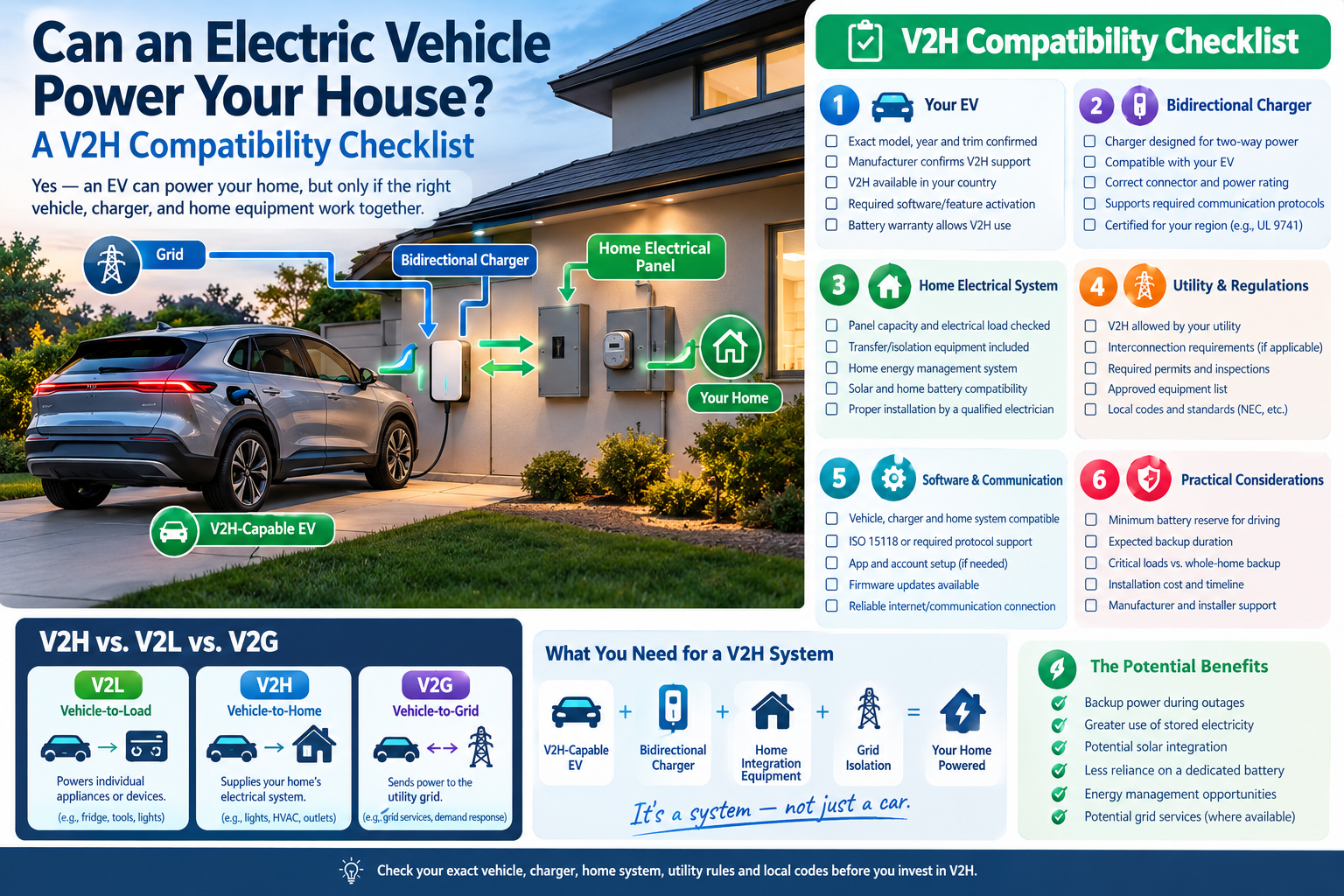
Yes, an electric vehicle can power a house, but only if the vehicle, charging equipment, home electrical system, and control equipment are designed for bidirectional power flow.
This technology is called Vehicle-to-Home, or V2H.
Unlike a normal EV charger, which sends electricity in one direction—from the home to the vehicle—a V2H system can send stored energy from the EV battery back to the home.
The U.S. Department of Energy describes bidirectional EVs as mobile energy storage that can provide power to external loads when paired with appropriately capable EV supply equipment.
That doesn’t mean every electric car can be used as a home battery.
An EV may have a large battery but still lack the hardware or software necessary to export electricity to a home’s electrical system. Even an EV with bidirectional capability may require a specific charger, home integration equipment, electrical isolation equipment, and approved installation.
This V2H compatibility checklist explains exactly what to check before assuming your EV can power your house.
What Is V2H?
V2H stands for Vehicle-to-Home.
It describes a system in which electricity can flow:
Home → EV
for normal charging, and:
EV → Home
when the vehicle is supplying the house.
A simplified V2H system looks like this:
        GRID
          │
          ▼
   ┌──────────────┐
   │ Home Electrical│
   │     Panel      │
   └───────┬────────┘
           │
     Bidirectional
        EV Charger
           │
           ▼
      ┌─────────┐
      │   EV    │
      │ Battery │
      └─────────┘
During normal operation, electricity charges the EV.
During a power outage, the system can reverse the energy flow and use the EV battery to supply the home.
The exact architecture varies. In some systems, the power conversion equipment is primarily in the charger; in others, some conversion capability is inside the vehicle.
ISO 15118-20 defines communication requirements for bidirectional power transfer between EVs and EV supply equipment, including power transfer from the EV to external loads.
V2H Is Different From V2L
This distinction is extremely important.
You may have seen an EV advertised with Vehicle-to-Load (V2L) capability.
V2L allows the vehicle to provide electricity to external appliances or equipment.
For example, an EV might be able to power:
- A refrigerator
- Lights
- A laptop
- Camping equipment
- Power tools
- Small appliances
But V2L does not automatically mean V2H.
V2L
EV
 │
 ├── Refrigerator
 ├── Lights
 ├── Laptop
 └── Tools
V2H
EV
 │
 ▼
Bidirectional charger
 │
 ▼
Home electrical system
 │
 ├── Refrigerator
 ├── Lights
 ├── HVAC
 ├── Outlets
 └── Other selected loads
V2H is designed to integrate the EV with the home’s electrical system rather than simply providing power through individual vehicle outlets.
GM, for example, describes V2H as using a V2H-capable EV together with a bidirectional charger and V2H enablement equipment to provide backup power to a properly equipped home.
Bottom line: An EV having a power outlet is not enough to prove that it supports V2H.
V2H vs. V2G: What’s the Difference?
You’ll also see the term V2G, which means Vehicle-to-Grid.
The three terms describe different destinations for electricity.
| Technology | Energy flows from EV to |
|---|---|
| V2L | Individual appliances/loads |
| V2H | Your home |
| V2B | A building |
| V2G | The electrical grid |
V2H is primarily about supplying your home.
V2G goes a step further by allowing the EV to interact with the utility grid under appropriate technical and regulatory arrangements.
The International Energy Agency’s 2026 analysis describes bidirectional charging as an emerging technology that can support grid services, while noting that deployment and regulatory arrangements vary between markets.
You should therefore not assume that:
V2H = V2G
A vehicle and charger can support one function without supporting another.
The V2H Compatibility Checklist
Before buying equipment or changing your electrical system, check these requirements.
1. Does Your EV Support Bidirectional Power?
This is the first and most important question.
Look up your exact:
- EV make
- Model
- Model year
- Battery configuration
- Trim level
- Market/region
Don’t rely only on the manufacturer’s general statement that a vehicle is “bidirectional capable.”
Some features are available only on particular model years, trims, batteries, markets, or with additional equipment.
For example, Kia currently states that its V2H feature applies to certain EV9 models and requires the Quasar 2 bidirectional charger plus additional equipment.
GM likewise identifies specific V2H-capable EVs and requires its V2H equipment for home backup.
Checklist
Ask the manufacturer:
- Does my exact vehicle support V2H?
- Is V2H enabled in my country?
- Is a software update required?
- Is a specific battery configuration required?
- Is a specific charger required?
- Is V2H available now or only planned?
- Does using V2H affect the vehicle warranty?
If you cannot answer these questions, don’t purchase a V2H charger yet.
2. Does the EV Support Power Export, Not Just Smart Charging?
This is another important distinction.
A normal smart charger can intelligently control when the EV charges.
For example, it can charge:
- At night
- During low electricity rates
- When solar production is high
- When grid demand is low
But that’s still one-way charging.
The charger may control:
Grid → EV
without allowing:
EV → Home
For V2H, the vehicle and charging system must support power export.
ISO 15118-20 specifically defines communication requirements that support bidirectional energy transfer between the vehicle and EV supply equipment.
3. Do You Have a Compatible Bidirectional Charger?
A standard Level 2 charger is not automatically a V2H charger.
You need equipment specifically designed for bidirectional operation.
A V2H-capable system may include:
- Bidirectional EV charger
- EV power conversion equipment
- Home energy management equipment
- Metering
- Transfer/isolation equipment
- Communications hardware
- Control software
The U.S. Department of Energy explains that a bidirectional EV requires similarly capable EVSE to discharge energy to an external load.
Don’t confuse these two:
Standard EV charger
Home → EV
Bidirectional EV charger
Home ⇄ EV
The second setup requires substantially more coordination and safety equipment.
4. Does the Charger Work With Your Specific EV?
Even if both the vehicle and charger advertise bidirectional charging, compatibility still needs to be verified.
Check:
- Vehicle model
- Model year
- Connector
- Charging architecture
- Communication protocol
- Bidirectional charging mode
- Charger firmware
- Manufacturer-approved compatibility list
Don’t assume that two products will work together simply because they use the same physical connector.
The electrical connector is only one part of the system.
Enphase’s bidirectional charger documentation, for example, describes compatibility in terms of standards-based communication and manufacturer testing rather than simply relying on the physical connector.
5. Check the Charging Connector and Architecture
The connector matters, but it isn’t the entire compatibility story.
Depending on the vehicle and market, you may encounter:
- CCS
- NACS
- J1772
- Type 2
- CHAdeMO
- Other regional standards
Some older EVs and charging systems have supported bidirectional applications through CHAdeMO, while newer systems are increasingly using standards and architectures associated with CCS/NACS ecosystems.
But the connector by itself doesn’t tell you whether V2H is supported.
For example:
Same connector ≠ guaranteed V2H compatibility.
You need to confirm the vehicle’s actual bidirectional power capability and the charger’s supported architecture.
6. Check Communication Compatibility
V2H isn’t just an electrical connection.
The vehicle, charger, home energy equipment, and potentially utility systems need to communicate correctly.
This can involve standards such as ISO 15118.
ISO 15118-20 defines communication between an EV and EV supply equipment and includes requirements for bidirectional power transfer.
The standard itself does not mean that every ISO 15118-equipped EV automatically supports V2H.
Instead, think of it as part of the communication framework.
Your actual system still needs compatible implementation and manufacturer support.
7. Does Your Home Have the Right Electrical Equipment?
This is where V2H becomes different from simply plugging in an appliance.
Your house needs a safe way to receive power from the EV.
Depending on the system, that can involve:
- Transfer equipment
- Backup gateway
- Energy management system
- Inverter
- Meter
- Main-panel integration
- Critical-load panel
- Automatic isolation equipment
The purpose is to control where electricity goes and prevent unsafe energization of the utility grid during an outage.
The National Electrical Code’s EV provisions address equipment connecting EVs to premises wiring for charging, power export, and bidirectional current flow.
UL also identifies UL 9741 as the standard covering EV power-export equipment with bidirectional capability.
8. Can the System Safely Disconnect From the Grid?
This is one of the most important V2H requirements.
Imagine the utility grid loses power.
Your EV is connected to your house.
If your EV continues sending electricity through the home’s electrical wiring and onto the utility lines, that can create a dangerous situation for utility workers repairing the outage.
A properly designed V2H system therefore needs to manage islanding and grid isolation.
In simple terms:
NORMAL OPERATION

Grid ───────► Home
               ▲
               │
              EV
During an outage:
GRID OUTAGE

Grid ✕────── Home
              ▲
              │
             EV
The home is electrically separated from the unavailable grid before the EV supplies the house.
GM describes its V2H system as using equipment that allows a compatible EV to supply a properly equipped home without sending electricity back onto public power lines during an outage.
Ford’s Home Backup Power system similarly uses a Home Integration System to disconnect the home from the grid before the F-150 Lightning supplies electricity during an outage.
Never improvise this connection with homemade wiring or an ordinary extension cord.
9. Is Your Electrical Panel Large Enough?
Your EV battery might contain a lot of stored energy, but that doesn’t mean your home’s electrical panel can accept unlimited power.
You need to consider:
- Main service capacity
- Panel rating
- Breaker configuration
- EV charger output
- Existing electrical loads
- HVAC
- Electric water heating
- Electric cooking
- Heat pumps
- Solar inverter
- Battery storage
- Load management
A V2H installation may require load management to keep total demand within the home’s electrical limits.
For example, if your EV can provide 11 kW but your home is simultaneously running:
- 4 kW HVAC
- 4 kW water heater
- 2 kW cooking appliances
- 1 kW refrigerator and other loads
you are already around 11 kW.
Adding another major load could exceed the available power.
Some modern bidirectional systems include dynamic load management. Enphase, for example, says its bidirectional charger can adjust EV power flow based on main-panel capacity.
10. Whole-Home Backup or Critical Loads?
You need to decide what you actually want to power.
There are two common approaches.
Whole-home backup
The V2H system supplies the home’s main electrical system.
Potential loads could include:
- Refrigerator
- Lights
- Internet
- HVAC
- Kitchen
- Outlets
- Water heater
- Other household circuits
Whether all of these can run simultaneously depends on the system’s power rating and your home’s electrical design.
Critical-load backup
Instead of powering everything, selected circuits are backed up.
For example:
BACKUP PANEL

✓ Refrigerator
✓ Internet
✓ Lights
✓ Security system
✓ Selected outlets
✓ Medical equipment

✕ EV charger
✕ Pool heater
✕ Large electric heater
✕ Other high-power loads
Critical-load backup can reduce the amount of power required from the EV.
11. Check the V2H Power Rating
Don’t look only at battery capacity.
Two separate specifications matter:
Energy capacity
Measured in:
kWh
This tells you approximately how much stored energy is available.
Power output
Measured in:
kW
This tells you how much power the system can provide at a particular moment.
A vehicle could have a very large battery but a V2H system that limits home output to a lower power level.
For example:
80 kWh battery
doesn’t automatically mean:
80 kW home output.
The charger, inverter, vehicle, wiring, and home equipment determine the available power.
12. How Much Energy Does Your House Actually Use?
Before installing V2H, look at your home’s electricity consumption.
Your utility bill may show monthly kWh usage.
Your smart meter or energy-monitoring system may provide more detailed information.
Suppose your home averages:
30 kWh per day
and your EV has:
80 kWh of usable battery energy
It might appear that the EV could theoretically provide several days of household energy.
But that calculation is too simplistic.
You have to account for:
- Battery reserve
- Conversion losses
- V2H power limits
- Vehicle energy needs
- HVAC
- Weather
- Battery state of charge
- System efficiency
- Whether the EV needs to leave home
So don’t interpret battery capacity as guaranteed backup duration.
13. Keep Enough Battery for Driving
One of the biggest practical questions is:
What happens if the power goes out and I need to drive?
Your EV isn’t only a home battery.
It’s also your transportation.
A good V2H system can manage a minimum state of charge so that some energy remains available for driving.
Ford says its Home Power Management system can manage charge and transfer cycles while ensuring the vehicle retains enough charge for the driver’s needs.
Kia’s V2H documentation also specifies a minimum battery state of charge for using its V2H function.
The exact reserve depends on the vehicle and system.
14. Does Your EV Support V2H With Solar?
This is an especially useful combination.
Imagine:
              SOLAR
                │
                ▼
              HOME
             ↙    ↘
          BATTERY  EV
During the day, solar can produce electricity.
Some of that electricity can run the home.
Surplus energy may charge the EV.
Later, the EV can potentially provide power to the house.
The exact control strategy depends on the equipment.
DOE notes that bidirectional EVs can complement solar PV and other distributed energy resources.
However, solar compatibility must be verified for the specific V2H equipment.
Don’t assume that adding a bidirectional charger to an existing solar system automatically creates a compatible integrated system.
15. Check Your Solar Inverter and Battery
If you already have:
- Rooftop solar
- A solar inverter
- A home battery
- A smart electrical panel
you need to check how the V2H system interacts with them.
Potential questions include:
- Can the EV charge from solar?
- Can the EV discharge while solar is operating?
- Can the solar system operate during a grid outage?
- Does the V2H system provide grid-forming capability?
- Does the home battery need to remain connected?
- Can the systems communicate?
- Which device controls the backup system?
- Is the solar inverter compatible with islanded operation?
These are system-design questions rather than simple EV compatibility questions.
DOE describes V2B/V2H-type bidirectional systems as potentially complementing solar PV and other distributed energy resources, but the actual architecture depends on the equipment.
16. Check Your Utility’s Rules
V2H and V2G rules vary by location.
A system used only for isolated home backup may be treated differently from a system that exports electricity to the utility grid.
V2G generally introduces additional grid-interconnection considerations because electricity can intentionally flow from the EV toward the utility network.
UL notes that bidirectional charging involves grid interconnection requirements and safety standards, while the IEA reports that regulatory and market arrangements for bidirectional charging differ across countries.
Before installation, ask your utility:
- Is V2H permitted?
- Is V2G permitted?
- Is an interconnection application required?
- Is a separate meter required?
- Are there export limits?
- Are there approved equipment requirements?
- Does the utility need to approve the charger?
- Are there special tariffs or programs?
If you live outside the United States, don’t automatically apply U.S. NEC or UL requirements to your installation. Your local electrical code, utility, and certification requirements take precedence.
17. Check Local Permits and Electrical Codes
V2H involves high-power electrical equipment.
Depending on your location, installation may require:
- Electrical permit
- Inspection
- Utility approval
- Certified installer
- Specific equipment certification
- Grid-interconnection documentation
The current NFPA 70 edition is the 2026 National Electrical Code in the United States, and its EV provisions cover equipment associated with charging, power export, and bidirectional current flow.
UL identifies UL 9741 for EV power-export equipment and also references grid-interconnection standards relevant to bidirectional systems.
Your local rules may be different.
18. Check Whether the Charger Is Certified for the Intended Use
Don’t buy a generic “bidirectional charger” simply because its product description says it can send power backward.
Look for equipment that is properly certified for the application and jurisdiction.
For North American installations, UL 9741 is specifically associated with electric vehicle power-export equipment. UL also discusses the relationship between bidirectional EV equipment and grid-interconnection standards.
In other countries, different IEC, national, or regional standards may apply.
Your installer should be able to identify the applicable requirements.
19. Check Software and Firmware Support
V2H is partly a software problem as well as an electrical one.
The vehicle may require:
- Firmware support
- An activated feature
- A mobile app
- An energy-management account
- A specific charger firmware
- Cloud connectivity
- Manufacturer authorization
For example, Kia’s V2H implementation requires activation through Kia Connect in addition to the appropriate charger and equipment.
GM likewise combines its V2H-capable vehicles with dedicated energy equipment and enablement hardware.
Therefore, ask:
Is V2H enabled on my vehicle today, or is the hardware merely capable of supporting it?
Those aren’t necessarily the same thing.
20. Check Warranty and Battery-Use Conditions
Using your EV battery for home backup means the battery is doing more than transportation.
Ask the manufacturer:
- Is V2H officially supported?
- Is bidirectional cycling covered by the warranty?
- Are there battery state-of-charge limits?
- Is there a minimum reserve?
- Is there a maximum discharge rate?
- Does frequent V2H use affect warranty terms?
- Is battery degradation treatment different?
Don’t assume that because a third-party system can technically discharge the battery, the vehicle manufacturer approves that use.
Examples of V2H Systems
The V2H market is evolving quickly, so compatibility should always be checked using current manufacturer documentation.
Ford F-150 Lightning
Ford’s F-150 Lightning can provide home backup when combined with the appropriate Ford Charge Station Pro and Home Integration System. Ford describes the system as automatically disconnecting the home from the grid and providing electricity during an outage.
Ford also distinguishes its Home Backup Power feature from its newer Home Power Management functionality, which can use stored EV energy for energy-management purposes in selected markets.
The important lesson is that the truck alone isn’t the complete V2H system.
Kia EV9
Kia currently documents V2H capability for certain EV9 models and says the system requires a Quasar 2 bidirectional charger and additional equipment. Kia also specifies a minimum battery state of charge for its V2H function.
Again, the example illustrates why checking the exact model, market, charger, and additional equipment matters.
GM EVs
GM says V2H-capable vehicles can provide backup power to a properly equipped home when paired with the GM Energy PowerShift Charger and V2H Enablement Kit. GM’s current system includes home-side equipment such as a Home Hub, inverter, and other components depending on configuration.
GM’s current materials identify multiple V2H-capable EVs and describe V2H as a system rather than simply a vehicle feature.
What About Enphase?
Enphase has developed a bidirectional EV charger architecture intended for V2H and V2G applications.
Its current product information describes bidirectional power flow between the EV, home, and grid, along with integration with its home energy ecosystem. It says the system is designed around ISO 15118 standards and tested for compatibility with compliant vehicles.
Enphase has also stated that its global bidirectional EV charging platform was targeting volume production in late 2026, illustrating how quickly this technology is developing.
For consumers, the takeaway is simple:
Always check current availability in your country before designing a system around a product that is still rolling out.
Can Any EV Be Turned Into a Home Battery?
No.
A large EV battery alone isn’t enough.
A complete V2H system needs compatible components that can safely control the energy flow.
Think of it as a chain:
EV
 ↓
Bidirectional capability
 ↓
Compatible charger
 ↓
Home integration equipment
 ↓
Grid isolation
 ↓
Electrical panel
 ↓
Home loads
If one important component isn’t compatible, the complete V2H system may not work.
Can You Use a Normal EV Charger for V2H?
Generally, no.
A conventional charger is designed primarily to send electricity into the EV.
V2H requires equipment capable of controlled reverse power flow.
The Department of Energy explicitly describes bidirectional EVs as needing similarly capable EVSE to discharge energy to an external load.
So if your existing charger is a normal one-way Level 2 charger, don’t assume a software update will turn it into a V2H system.
Can You Use an Extension Cord to Power Your House?
You should not attempt to back-feed a home’s electrical wiring using an improvised extension-cord arrangement.
There is an important difference between:
Powering an individual appliance
and:
Energizing the home’s electrical system.
A proper V2H system controls the connection between the EV and the home’s electrical infrastructure and provides the necessary isolation from the utility grid.
UL’s guidance on EV power-export equipment specifically addresses equipment intended to distribute exported EV power to premises or loads and installation in accordance with applicable electrical codes.
Use equipment and installation methods approved for your specific application.
How Long Can an EV Power a House?
There isn’t one universal answer.
The basic calculation is:
Runtime ≈ usable battery energy ÷ average home power consumption
For example, suppose an EV has:
70 kWh usable energy
and your home averages:
2 kW
of load.
A simplified theoretical calculation would be:
70 ÷ 2 = 35 hours
But this is not a guaranteed real-world runtime.
Actual runtime can be lower because of:
- Conversion losses
- Battery reserve
- Temperature
- HVAC cycling
- Higher loads
- V2H power limits
- Vehicle driving requirements
- Battery state of charge
- System efficiency
Ford, for example, states that its home-backup duration depends on energy consumption and system conditions rather than being a fixed number of days for every household.
GM similarly provides model-specific backup estimates and notes that actual usage varies.
EV Battery vs. Home Battery
An EV can have substantially more stored energy than a typical residential battery, but the two serve different purposes.
| Feature | EV battery | Home battery |
|---|---|---|
| Primary purpose | Transportation | Energy storage |
| Can move locations | Yes | No |
| Large energy capacity | Often | Varies |
| Can power home | Some models | Many systems |
| Requires bidirectional equipment | For V2H | Usually integrated |
| Needs to remain at home | No | Yes |
| Can be used for driving | Yes | No |
The major advantage of V2H is that you can potentially use one battery for both transportation and backup energy.
The major limitation is that you may need to leave home with that battery.
V2H Compatibility Checklist
Before purchasing anything, work through this checklist.
Vehicle
- Exact EV model confirmed
- Exact model year confirmed
- Correct trim/battery confirmed
- Manufacturer confirms V2H support
- V2H available in your country
- Software/feature activation confirmed
- Battery warranty allows V2H use
Charger
- Bidirectional charger required
- Charger compatible with exact EV
- Correct connector
- Correct voltage
- Correct power rating
- Required communication protocols supported
- Appropriate certification confirmed
Home electrical system
- Main panel evaluated
- Available electrical capacity checked
- Backup loads identified
- Transfer/isolation equipment included
- Required inverter/gateway included
- Load management considered
- Solar compatibility checked
- Home battery compatibility checked
Utility and regulations
- Utility requirements checked
- V2H allowed
- V2G rules checked if applicable
- Required permits identified
- Required inspections identified
- Approved equipment confirmed
- Qualified installer available
Practical considerations
- Minimum EV battery reserve established
- Desired backup duration estimated
- Critical loads identified
- Driving requirements considered
- Installation cost estimated
- Manufacturer support confirmed
If you can’t check the first few boxes, stop before purchasing a charger.
A Simple V2H Compatibility Scorecard
Instead of looking at a vehicle’s battery size, evaluate these five areas:
| Requirement | Question |
|---|---|
| Vehicle | Can this exact EV export power for V2H? |
| Charger | Is there a compatible bidirectional charger? |
| Home | Can the electrical system safely receive the power? |
| Grid | Can the system isolate from the utility during outages? |
| Rules | Is the installation permitted and approved locally? |
All five matter.
A vehicle can have a huge battery and still fail the checklist if it lacks V2H capability.
What to Ask a V2H Installer
Before accepting a quote, ask these questions:
- Is my exact EV model approved for this system?
- Which bidirectional charger will you install?
- What is the maximum V2H output in kW?
- How much usable energy can the system access?
- Does it provide whole-home or critical-load backup?
- How does it disconnect from the grid during an outage?
- Can it work with my existing solar system?
- Can it work with my existing home battery?
- What happens if the EV reaches its minimum battery reserve?
- What happens if I need to drive the car during an outage?
- What permits are required?
- Does my utility need to approve the installation?
- Which components are certified for my location?
- Does V2H affect the EV warranty?
- What happens if internet service is unavailable?
- Can the system operate during a complete grid outage?
- What loads can run simultaneously?
- What is the expected installation cost?
- What maintenance is required?
- Who supports the system if the EV, charger, or home equipment stops communicating?
A good installer should be able to answer these questions with documentation rather than guesses.
The Most Common V2H Mistakes
Mistake 1: Assuming every EV is bidirectional
It isn’t.
Check the exact vehicle.
Mistake 2: Confusing V2L with V2H
A vehicle that can power appliances isn’t necessarily capable of powering a home’s electrical panel.
Mistake 3: Looking only at battery capacity
An 80 kWh battery doesn’t automatically provide 80 kW of home power.
Mistake 4: Ignoring the electrical panel
Your home’s maximum electrical demand matters.
Mistake 5: Forgetting grid isolation
A backup system must be designed so it doesn’t improperly energize the utility network during an outage.
Mistake 6: Assuming the connector guarantees compatibility
The connector is only one part of the system.
Mistake 7: Ignoring utility rules
V2H and V2G may have different requirements depending on location.
Mistake 8: Assuming advertised backup time applies to everyone
Your home’s energy consumption determines how quickly the EV battery is depleted.
Mistake 9: Buying equipment before checking the complete ecosystem
A V2H system is made up of multiple interconnected components.
Is V2H Worth Considering?
V2H can turn an EV into a mobile energy-storage resource.
The potential benefits include:
- Backup power during outages
- Greater use of stored electricity
- Potential integration with solar
- Reduced reliance on a dedicated stationary battery
- Energy-management opportunities
- Potential grid-services participation where available
The DOE identifies resilience and demand-response applications as important uses for bidirectional EVs.
The IEA also reports that smart and bidirectional charging can provide grid benefits, although market rules and deployment differ substantially between regions.
But V2H also adds complexity.
You may need:
- A compatible EV
- A bidirectional charger
- Additional home equipment
- Electrical work
- Software
- Utility coordination
- Permits
- A qualified installer
So the right question isn’t simply:
“Does my EV have a big battery?”
It’s:
“Can my entire vehicle, charger, home, and utility setup support V2H?”
Frequently Asked Questions
Can an electric vehicle power an entire house?
Some V2H-capable EV systems can supply a properly equipped home, but whether they can power the entire house simultaneously depends on the vehicle’s power output, charger, home electrical system, and load requirements.
Some systems are designed for whole-home backup, while others can prioritize selected circuits.
Does an EV need a bidirectional charger for V2H?
A V2H system requires appropriately capable power-transfer equipment. The DOE describes bidirectional EVs as requiring similarly capable EVSE to discharge power to an external load.
Is V2H the same as V2L?
No.
V2L generally provides electricity to external appliances or loads. V2H is designed to supply the home’s electrical system through appropriate integration equipment.
Is V2H the same as V2G?
No.
V2H supplies the home.
V2G involves sending electricity to the utility grid under an appropriate grid-interconnected system.
Can I use my existing Level 2 charger for V2H?
Not automatically.
A standard one-way charger isn’t necessarily capable of reverse power flow. You need equipment specifically designed and approved for bidirectional operation.
Does V2H work during a power outage?
It can, provided the vehicle, charger, home equipment, and control system are designed for backup operation.
The system must safely separate the home from the utility grid when necessary.
Can V2H work with solar panels?
Yes, some systems are designed to integrate EVs with solar, but compatibility depends on the specific EV, bidirectional charger, inverter, energy-management equipment, and backup architecture. DOE identifies bidirectional EVs as a potential complement to solar PV and other distributed energy resources.
Will V2H drain my EV battery?
Yes, supplying your home consumes energy from the EV battery.
A properly designed system can maintain a minimum state of charge so that you retain energy for driving. The exact reserve is manufacturer-specific.
Can V2H send power back to the grid?
Not necessarily.
V2H and V2G are different functions. Grid export requires equipment and utility arrangements that support grid-interactive operation.
Can I install a V2H system myself?
Because V2H involves high-power electrical equipment and potentially grid isolation, installation should be handled according to applicable electrical codes and by appropriately qualified professionals.
UL identifies specific safety and interconnection standards for bidirectional EV power-export equipment.
Final V2H Compatibility Checklist
Before deciding that your EV can power your home, confirm these 10 essentials:
1. V2H-capable EV
Your exact model and year must support vehicle-to-home power export.
2. Bidirectional charger
You need equipment capable of safely transferring electricity in both directions.
3. Vehicle-charger compatibility
The EV and charger must be approved to work together.
4. Communication compatibility
The vehicle, charger, and energy-management equipment need compatible communications.
5. Home integration
Your electrical panel and home equipment must be designed to receive EV power.
6. Grid isolation
The system must prevent unsafe backfeeding during a utility outage.
7. Appropriate power rating
The system must provide enough kW for the loads you intend to operate.
8. Enough usable battery energy
Your EV must have enough available kWh for the desired backup duration.
9. Utility and code compliance
Your installation must meet the requirements applicable to your location.
10. Professional system design
The complete EV + charger + home + grid configuration should be evaluated together.
Bottom Line: Can an EV Power Your House?
Yes—but only when the entire V2H system is compatible.
The EV itself is only one part of the equation.
A practical V2H system looks like:
V2H-capable EV + bidirectional charger + compatible home equipment + safe grid isolation + electrical capacity + appropriate software/communications + local approval
The most important thing to remember is that battery size alone does not make an EV a home battery.
Check your exact EV model first. Then verify the compatible bidirectional charger, home integration equipment, electrical-panel capacity, backup configuration, utility requirements, and local codes.
V2H technology is developing quickly. Current systems from manufacturers such as Ford, Kia, GM, and Enphase demonstrate different approaches, equipment combinations, and availability requirements, so always use current manufacturer documentation for the exact vehicle and region you’re considering.
If all of those pieces line up, your EV can become more than transportation: it can function as a mobile energy-storage resource for your home.